When Teaching Hard Isn’t the Problem
For many teachers, there comes a moment when the usual approach stops making sense.
I’m not sure why they don’t get it.
I’ve explained how to solve the problems. We’ve practiced. But they keep mixing up what to do when. It works for a while, and then when we move on, it’s like they forget everything we just did.
They aren’t making the connections I wish they were.
I’m working hard and trying everything I can think of, but it’s just not working. I know there has to be something I’m missing.

Susan Smith knows that moment well
After 34 years teaching fourth grade, Susan’s students looked successful by every traditional measure. They scored well on tests. They followed procedures. They could carry out the steps they had been taught.
Then she asked them to solve 78+99 mentally. They were completely stuck.
Instead of thinking about the numbers, students immediately reverted to an algorithm.
That moment revealed something important. Her students knew the steps, but they weren’t reasoning about the mathematics.
Susan’s story of recognizing that gap—and shifting her teaching to build real mathematical reasoning—is one of the most honest examples of this transition from a classroom teacher.
If you’ve ever felt like your effort and hard work aren’t producing the kind of mathematical thinking you want for your students, you’re not alone.
And you’re in the right place.
Read Susan's full storyWhat This Book Helps You Do
This book is designed to help teachers build classrooms where students:
✔ Reason about numbers instead of memorizing steps
✔ Develop flexible strategies instead of relying on rules
✔ See relationships within mathematics
✔ Explain and justify their thinking
✔ Approach problems with confidence
Instead of asking students to remember what to do, this book focuses on helping them understand why mathematics works.
What This Book Helps You Do
This book is designed to help teachers build classrooms where students:
✔ Reason about numbers instead of memorizing steps
✔ Develop flexible strategies instead of relying on rules
✔ See relationships within mathematics
✔ Explain and justify their thinking
✔ Approach problems with confidence
Instead of asking students to remember what to do, this book focuses on helping them understand what mathematics is all about.

Inside the Book
You’ll find practical tools you can use right away, including:
Problem Strings
Carefully designed sequences of problems that help students notice patterns and develop strategies.
Strategy Development
Ways to help students build efficient strategies for addition, subtraction, multiplication, and division.
Models That Reveal Structure
Visual models that make mathematical relationships clear.
Teacher Moves That Support Thinking
Questions and important nudges that encourage students to reason, explain, and connect ideas.
Classroom Examples
Real examples of student thinking and how teachers respond to it.
Who This Book is For
This book is especially helpful for teachers who:
✔ Notice students can perform steps but struggle to reason
✔ Want students to solve problems efficiently and flexibly
✔ Are tired of reteaching procedures that never seem to stick
✔ Want math instruction that builds understanding, not dependency
✔ Are ready to help students become confident mathematical thinkers
Whether you teach third, fourth, or fifth grade, the ideas in this book are designed to help students build the reasoning they need for the mathematics ahead.
From Procedures to Reasoning
Traditional math instruction often looks like this:

But when students only learn steps, the mathematics never really belongs to them.
When students develop reasoning, something different happens.
They begin to:

That shift, from mimicking steps to reasoning about mathematics, is what this book is all about.
Ready to Help Students Think Mathematically?
If you want students who reason instead of mimic.
If you want mathematics to make sense to your learners.
If you want strategies that build thinking instead of dependence.
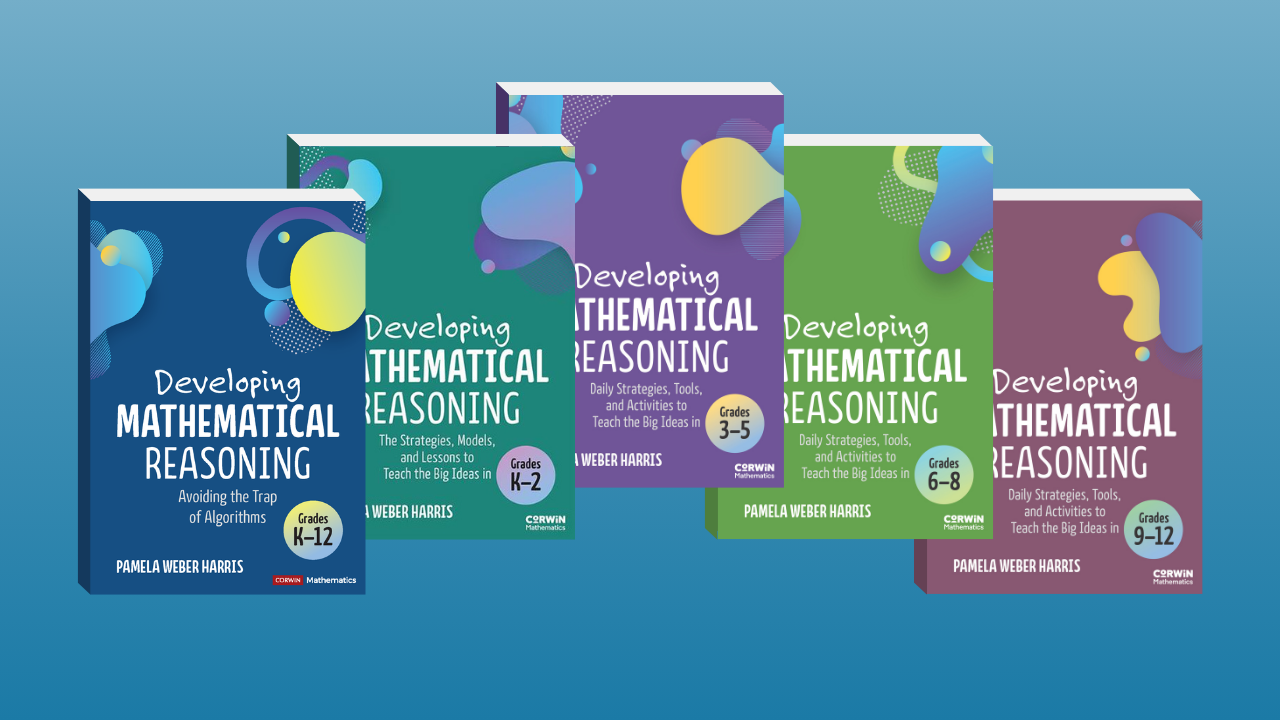
Developing Mathematical Reasoning: The Strategies, Models, and Lessons to Teach the Big Ideas in Grades 3–5 will show you how.
Description
Math is not rote-memorizable. Math is not random-guessable. Math is figure-out-able.
Author Pamela Weber Harris argues that teaching real math—math that is free of distortions—will reach more students more effectively and result in deeper understanding and longer retention. This book is about teaching undistorted math using the kinds of mental reasoning that mathematicians do.
Memorization tricks and algorithms meant to make math “easier” are full of traps that sacrifice long-term student growth for short-lived gains. Students and teachers alike have been led to believe that they’ve learned more and more math as they move through the content, but in reality students are not necessarily progressing in their ability to reason mathematically.
Using tricks may make facts easier to memorize in isolation, but that very disconnect distorts the reality of math. The mountain of trivia piles up until students hit a breaking point. Humanity's most powerful system of understanding, organizing, and making an impact on the world becomes a soul-draining exercise in confusion, chaos, and lost opportunities.
In her landmark book Developing Mathematical Reasoning: Avoiding the Trap of Algorithms, Pam emphasized the importance of teaching students increasingly sophisticated mathematical reasoning and understanding underlying concepts rather than relying on set rules for solving problems. Now, this next companion volume, Developing Mathematical Reasoning: The Strategies, Models, and Lessons to Teach the Big Ideas in Grades 3–5, equips educators with practical tools to move beyond rote memorization toward true mathematical thinking for students in upper elementary grades. Focusing on additive and multiplicative reasoning, the book introduces strategies designed to improve mathematical reasoning, Problem Strings, and strategic modeling to strengthen student understanding.
Highlights include:
- Reasoning-based strategies: Replace traditional algorithms with approaches that build critical thinking while ensuring understanding
- Problem Strings: Step-by-step guidance on walking students through a sequence of problems that spark insight
- Grade 3–5 focus: Comprehensive coverage of additive and multiplicative reasoning tailored for upper elementary learners
- Practical tools: Ready-to-use routines, discussion prompts, and modeling techniques for immediate classroom application
Help students learn to think mathematically rather than memorize. Build confidence, deep understanding, and an appreciation for the logic and beauty of math.
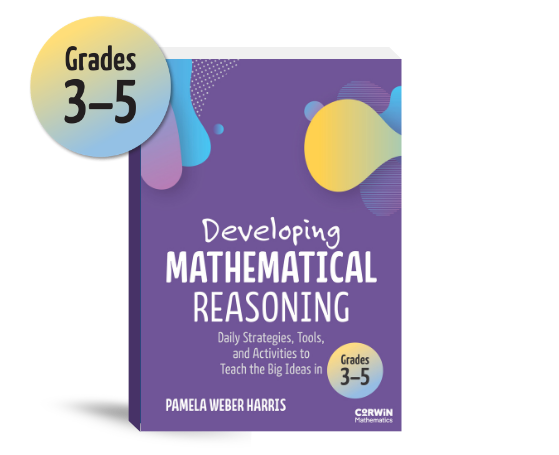
Table of Contents
Voices from experts in the field

Jo Boaler
NOMELLINI & OLIVIER PROFESSOR OF EDUCATION, STANFORD UNIVERSITYSTANFORD, CA
“What happens when you shift math from being about rote memorizing and mimicking to focusing on strategies, thinking, and reasoning? There is no one better than Pam Harris to guide you in this important path—and this one is for you, grade 3–5 teachers!”

Peter Liljedahl
PROFESSOR, SIMON FRASER UNIVERSITY; AUTHOR, BUILDING THINKING CLASSROOMS, VANCOUVER, BRITISH COLUMBIA, CANADA
“In this book, Pam Harris continues her quest to make math figure-outable-this time for grade 3-5 teachers. Through real classroom examples, Harris teaches us how addition, subtraction, multiplication, and division strategies should be experienced and understood, and she gives us the tools o teach these central ideas in mathematics.”

Jennifer M. Bay-Williams
PROFESSOR, UNIVERSITY OF LOUISVILLE, PEWEE VALLEY, KY
“Through extensive use of representations and illustrations, Pam Harris effectively illustrates how to develop reasoning strategies developmentally across the operations. Smudge problems and number strings appearing throughout the book provide enriching ideas for how to help students make sense of strategies and become reasoners. An excellent, practical resource for developing computational fluency.”

Pam Harris
Author
Pam Harris, author of Developing Mathematical Reasoning: Avoiding the Trap of Algorithms, is shifting the way we view and teach mathematics. She is a mom, former high school math teacher, university lecturer, author, and the Founder of Math is FigureOutAble.
Math teachers around the world rave about her online Building Powerful Mathematics workshops. For over 20 years, Pam has been helping leaders and teachers reach more students in less time so that students math with confidence and success.
Pam's Full Body of Work
Pam's work spans K–12 and has helped thousands of educators move beyond procedures toward genuine mathematical reasoning. Her books include:
Developing Mathematical Reasoning: Avoiding the Trap of Algorithms, the foundational K–12 text behind this webinar's core ideas.
The Numeracy Problem String Series (Kindergarten–Fifth Grade), grade-by-grade volumes of ready-to-use classroom routines that build number sense and relational thinking.
Building Powerful Numeracy for Middle and High School Students, its companion Lessons and Activities volume, and the Algebra and Advanced Algebra Problem Strings, bringing the same reasoning-first approach to secondary classrooms.
Explore all of Pam's books