A Year of Growth Through Problem Strings

Guest blog: Susan Smith, Elementary Math Teacher.
Today was a good day. A very good day. The kind of day where you feel energized and gratified to be a teacher. Today I had the opportunity to teach a Problem String in three different classrooms and spend some time with each teacher reflecting on their Math is FigureOutAble journey this year. The month of May is often when teachers begin to clearly see the impact of all their efforts in the growth that their students have made throughout the year. I invite you to join me as I share the highlights and takeaways from each of these visits.
Jennifer Hall’s Class: 3rd grade
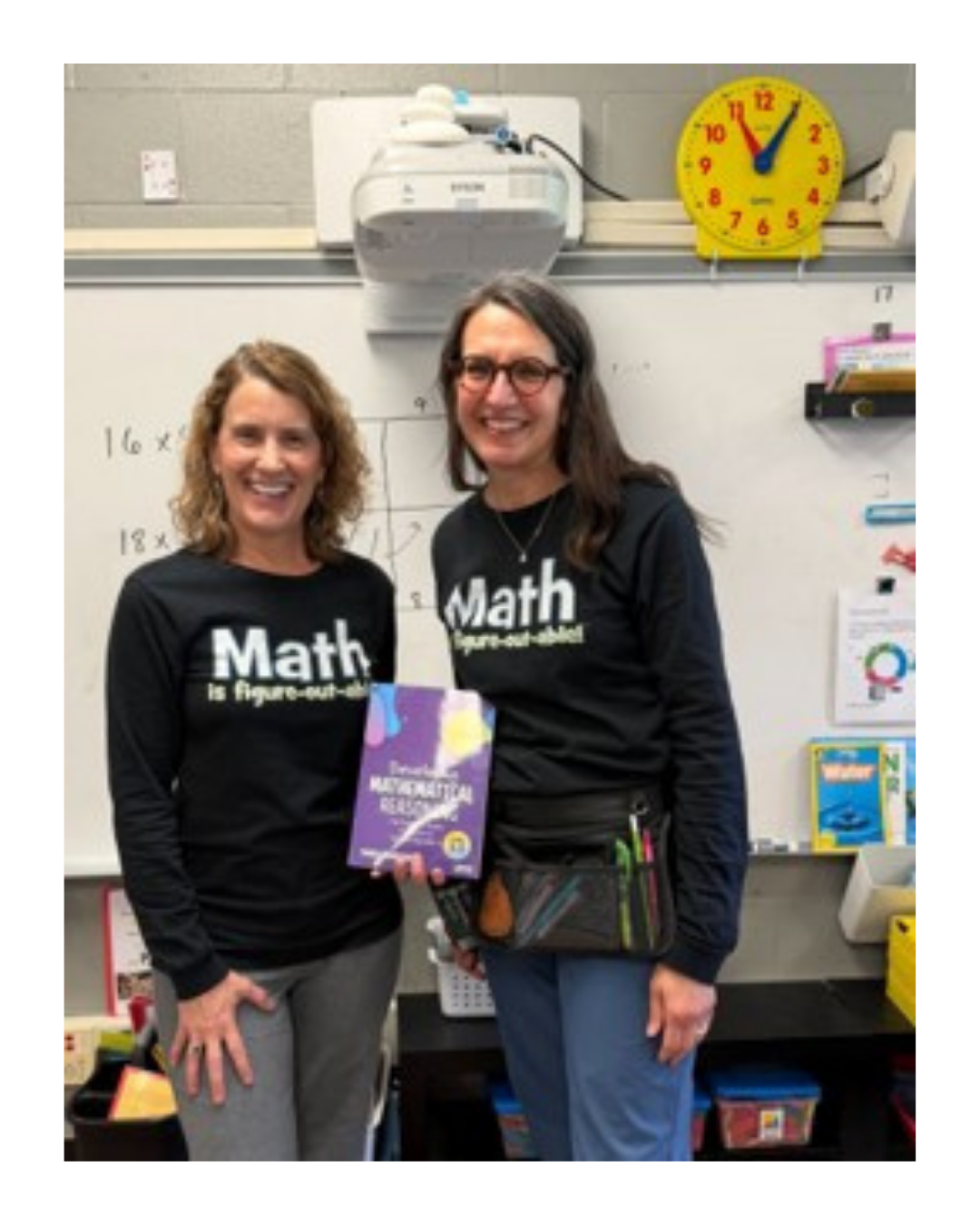 “Mrs. Smith is here. We get to do math!” I hear students exclaim joyfully as I enter the room. Nothing melts a math teacher’s heart faster than kids who are excited to do math. I have been periodically coming into Jennifer’s 3rd grade class since the beginning of the year to model Problem Strings, so the students know what to expect when they see me. I facilitate a Problem String on Doubling and Halving and marvel at the students’ eagerness and willingness to think about the math, look for patterns, use what they know, share their ideas, and try new things. It is such a contrast to those first lessons back in August and September when students were more timid, less confident, and unsure of what to do. It is also very apparent that Jennifer had been doing Problem Strings with them in between my visits all year long.
When the string ends and the students are off to lunch, Jennifer and I have a chance to talk. She shares with me her spring MAP testing data and the significant growth of her students this year, which far exceeded the growth of the previous year’s class. Jennifer then asks herself the question, “What changed?” She used the same math program. The students are different of course, but overall a typical class in comparison to last year. Upon reflection she shares that the only thing she has really done differently is implement Problem Strings on a regular basis throughout the year. But was that really the “only thing”? As we talk, it is clear to me that implementing Problem Strings was impactful, yes, but it was not just using that routine. Through her commitment to facilitating problem strings, Jennifer shifted in her perspective from a goal of answer-getting to a goal of developing mathematical reasoning in her students’ brains. That shift in mindset, moved her students’ growth into high gear. The message that math is figureoutable now permeates all of her math instruction.
Jennifer knows she is on the right track with her vision of what it means to teach math well. She has already read Developing Mathematical Reasoning: Avoiding the Trap of Algorithms during the school year and now plans to read the companion book, Developing Mathematical Reasoning: The Strategies, Models, and Lessons to Teach the Big Ideas in Grades 3 - 5. “Next year will be even better,” she says. I agree and hope to be invited back to support that journey and continue to be a part of it.
Compare the growth of Jennifer’s students last year to this year. Wow, this year’s class growth is phenomenal.
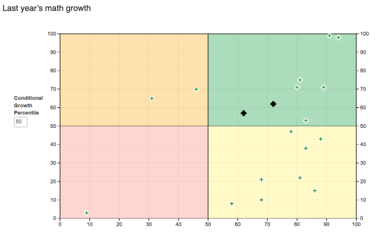
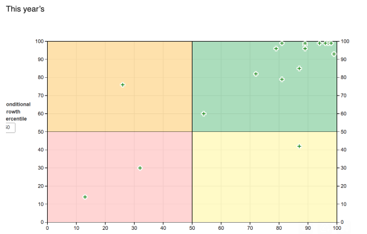
The + signs represent students. The quadrants signify the following:
Orange: High growth, low achievement. Pink: Low growth, low achievement. Yellow: Low growth, high achievement. Green: high growth and high achievement. (Goal!)
Tawnya Hartman’s Class, 3rd grade
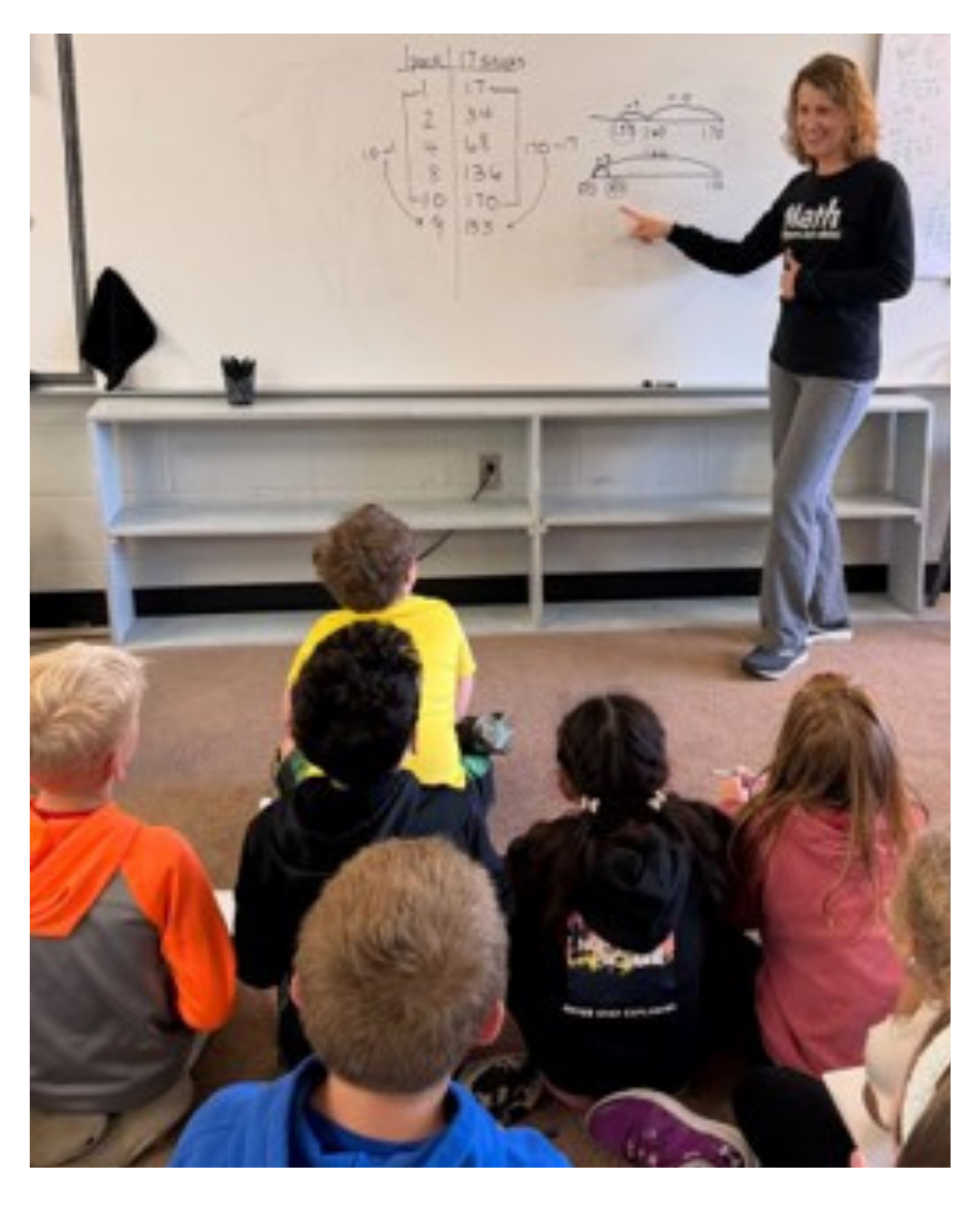 I walk into the smiling faces of 3rd graders ready to do math. They also know the Problem String routine and quickly come to the carpet with their white boards and markers giving me their full attention. Tawnya took Building Powerful Subtraction Workshop the previous year and has been routinely facilitating Problem Strings with her students. Anchor charts appear on her walls and it is even more evident when her students get right to thinking after I ask, “So if one pack of gum has 17 sticks, I am curious how many sticks I would get with 2 packs.” Numerous thumbs-up begin to appear, indicating students have an idea, with eager looks ready to share. After one student shares how she doubled 17 by adding 10+10 and then 7+7 and putting it all together to get 34, I ask, “I wonder, did anyone think about doubling 20 to find double 17?” When no one responds affirmatively, I ask, “Could you?” and then I see several nods. “Chris, you’re nodding, want to tell us what you are thinking?”
I have to smile when Chris says, “So you mean like the Over strategy.” Yep, this is a class who has definitely done Problem Strings and has been focusing on strategy. Chris continues, “I didn’t do that.” When I ask him if he would like to try it, he agrees and says, “So 20 + 20 is 40 and then 20 is 3 more than 17, so you have to subtract 6 because it is 6 too much, so you get 34.” I commend his willingness to share his thinking live and in the moment with us. It is clear that Tawnya has built a culture where her students feel safe to take risks and try new things.
After the string, Tawnya and I have a few moments to chat as the students prepare for the next activity. Tawnya says, “You know I am a believer. I am all in. Doing Problem Strings with my students this year has really pushed them to think and reason. Next year, I am going to be doing even more of this. This is what is making the difference. And my MAP scores really showed it too. Their growth was amazing.” She then goes on to share that she plans to take the Building Powerful Multiplication workshop this summer. She clearly feels empowered to teach math as figureoutable and is eager to grow even more in her craft. She also thanks me for teaching the string today because it gave her a chance to step back and watch her students. “I was so proud of them,” she says. “It felt amazing to see what they could do now and how they were thinking and engaging with the math. When you are in it, you don’t always see the growth. It was great to just observe and see how far they have come this year.”
Donna Jones’s Class, 2nd grade
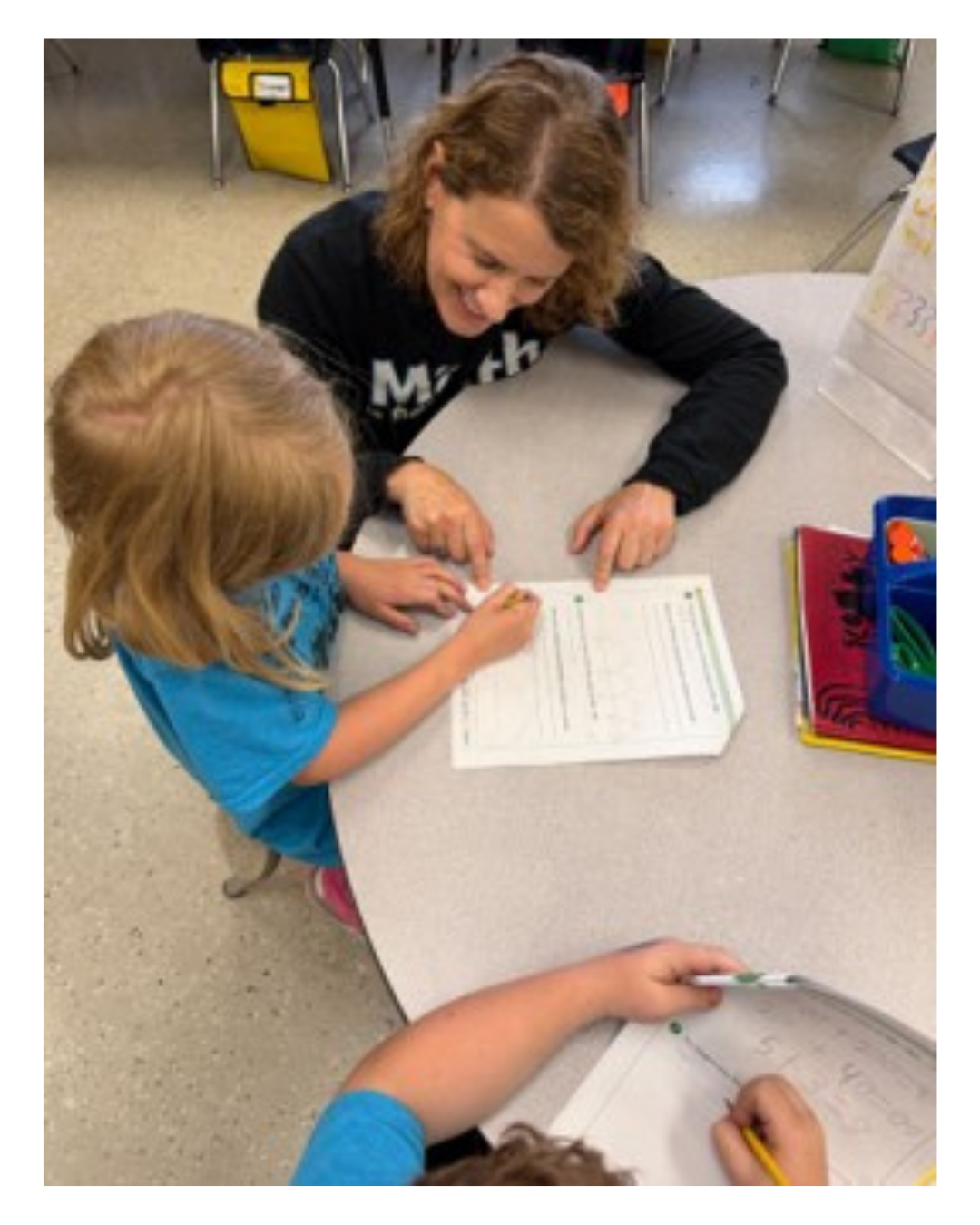 My visit to Donna’s room begins when the students are at recess, so our reflection time comes first. Donna is currently taking the Building Powerful Subtraction workshop. “You know, Susan, I am not a math person” she says, “But I am becoming one.” Now that makes me smile. She continues, “I am learning so much from this workshop and my own mental math and numeracy has really grown. It is amazing.” She then shares that she plans to take the Powerful Addition for Young Learners workshop this summer. She read Developing Mathematical Reasoning: The Strategies, Models, and Lessons to Teach the Big Ideas Grade K-2 earlier in the year, and plans to do some rereading of it this summer too. She has invited another colleague to join her in the journey next school year. “Next school year, I am starting from day one with Problem Strings, and I can’t wait,” she says.
The Problem String I facilitate in Donna’s room is Remove a Friendly Number. I did this strategy on a previous visit, but with smaller numbers. Today our numbers will be in the hundreds. I am struck again by the level of engagement and confidence of these students, which has really grown since I first visited back in November and began working with Donna to encourage and support her journey toward teaching more real math. Donna sees it too. When the students return to their desks to work on some independent problems, we are both encouraged by how many are using number lines and/or equations independently to make their own thinking visible or as a tool for thinking. I suggest that Donna’s next Problem String be on Distance vs. Removal. She exclaims with enthusiasm, “Oh my gosh, I just learned about that in the workshop. I just watched that module. Perfect.”
What Real Math-ing Looks Like
Real Math-ing. Focusing on the development of mathematical reasoning. Wanting correct answers, but wanting more than just getting answers. Students feeling empowered to use what they know to solve problems. Teachers feeling empowered to teach math as figureoutable. Both teachers and students growing, learning, and excited to continue their math journeys. This is what I saw today.
This is why today was a GREAT day.
The growth of these teachers didn’t happen by accident. It happened because they committed to helping students reason, think, and make sense of math. I honor their dedication to their craft and their students. If you’re ready to create that kind of classroom next year, join us in a Building Powerful Mathematics workshop and begin your own Math is FigureOutAble journey today.
Author

Pam Harris
Math Educator
Pam Harris is a mom, a former high school math teacher, a university lecturer, an author, and she wants to change the way we view and teach mathematics. While Pam was teaching high school math, her four children grew and mathematized their world in a way she had never imagined. “I had always bought into the myth that math is a disconnected set of facts to memorize, with rules and procedures to mimic. I now call that fake math.” Pam’s own kids, research, and experiences teaching real math have shown her what it means to mathematize and to support learners in their own journeys. Real math is thinking mathematically, not just mimicking what a teacher does on the board. You can shift your brain from using rote memory to mathematizing. Pam helps teachers make this shift for themselves, and helps teachers teach in a way that supports students to learn real math.
Stay connected with news and updates!
Categories
All Categories