Emmy Noether: Brilliant, Unpaid, Unstoppable
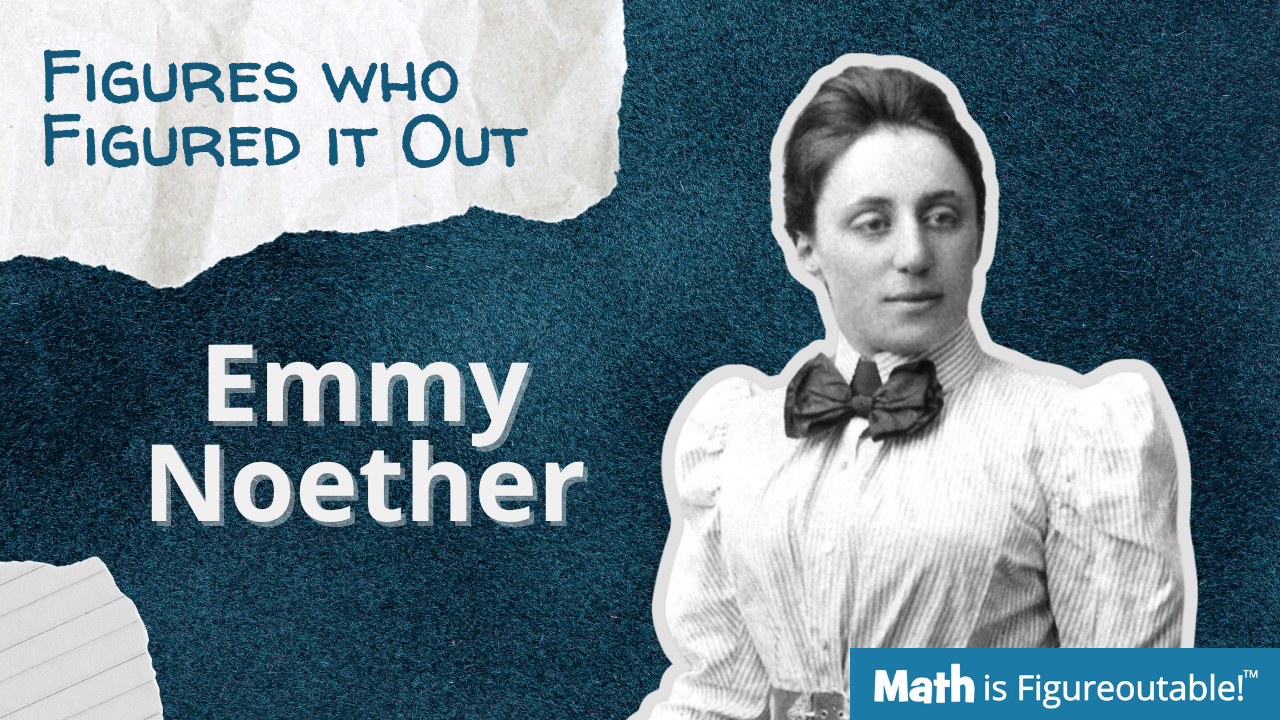
She Revolutionized Math and Physics Without a Salary: Here's What That Teaches Us About Persistence
Written by the Math is FigureOutAble Team
We're a team of educators and math thinkers who believe persistence, curiosity, and good teaching make math FigureOutAble for everyone.
The Woman Einstein Called a Genius
This post is part of our Figures Who Figured It Out series, where we explore the lives of mathematicians whose stories remind us that math isn't about perfection or genius. It's about persistence, curiosity, and figuring things out.
Imagine being so brilliant that Albert Einstein writes an obituary praising your work, yet much of the important work done in life happened without pay or recognition. Most of us would have given up. Emmy Noether kept revolutionizing mathematics.
When Emmy Noether was finally allowed to lecture at the University of Göttingen in 1919, it was only after a four-year fight. And even then, she taught for four years without a salary. Her courses were often listed under a male colleague's name. She didn't get an official title or real pay until 1922. But during those years without recognition or compensation, she developed ideas so fundamental that they underpin modern physics and mathematics.
If you've ever thought you can't do math because people don't take you seriously or conditions aren't fair, Noether's story might just inspire you to keep figuring it out anyway.
The Mathematician Who Turned Barriers into Breakthroughs
Emmy Noether faced obstacle after obstacle. As a woman in early 1900s Germany, she couldn't officially enroll as a regular student at university. She could only audit classes with professors' permission. She couldn't get paid positions. Colleagues opposed her appointments. The Nazis forced her to flee her country.
She responded by doing mathematics that would change the world. Her work was so important that when she died in 1935, Einstein wrote that she was "the most significant creative mathematical genius thus far produced since the higher education of women began."
From Language Student to Mathematical Revolutionary
Born in 1882 in Erlangen, Germany, Amalie Emmy Noether grew up in a mathematical household. Her father was a distinguished mathematician. Initially, she pursued certification to teach English and French, but a curiosity for mathematics pulled her back into that world. At the University of Erlangen, she was one of only two women among 986 students, allowed only to audit courses with individual professors' permission.
Despite these barriers, she earned her PhD in 1907 with a dissertation on algebraic invariants. For the next seven years, she worked at the Mathematical Institute in Erlangen without pay, helping her father and conducting her own research.
In 1915, mathematicians David Hilbert and Felix Klein invited her to Göttingen, the center of mathematical research in Germany. They wanted her help with problems in Einstein's new theory of general relativity. Hilbert fought to get her a position, famously arguing to the faculty, "Gentlemen, I do not see that the sex of a candidate is against her admission as a privatdozent. After all, the university senate is not a bathhouse."
He lost that fight initially. Noether lectured anyway, with courses listed under Hilbert's name. Finally, in 1919, she received permission to lecture. In 1922, she got the title "unofficial associate professor" and a modest salary—still far less than her male colleagues.
Her personality? Generous, passionate, and completely focused on ideas over credit. She freely shared her insights with students and colleagues. She would often develop profound theories in conversation and let others publish the results. She cared about mathematics, not recognition.
What Noether Figured Out: Contributions That Power Modern Science
Emmy Noether's work falls into roughly three periods, but her influence spans virtually all of modern mathematics and theoretical physics.
Noether's Theorem: The most important theorem in physics you've never heard of
In 1915, Noether proved something so fundamental that it changed how physicists understand the universe. Her theorem shows that every symmetry in nature corresponds to a conservation law. If physics works the same way tomorrow as today (that's time symmetry), energy must be conserved. If physics works the same here as a mile away (space symmetry), momentum must be conserved. If physics works the same at any angle (rotational symmetry), angular momentum must be conserved.
This one theorem unified all the conservation laws in physics. It's used constantly in particle physics, quantum mechanics, and cosmology. Physicist Leon Lederman called it "certainly one of the most important mathematical theorems ever proved in guiding the development of modern physics."
She revolutionized abstract algebra, creating a whole new way of thinking about mathematical structures. The concepts she developed (now called Noetherian rings) are fundamental tools used by mathematicians daily. Her work transformed algebra from the study of solving equations into the abstract, powerful field it is today.
She pioneered modern algebra, developing axiomatic approaches that let mathematicians work with abstract structures rather than specific calculations. This shift in perspective opened entirely new areas of mathematical research.
She founded representation theory, connecting abstract algebra to other areas of mathematics and physics in ways that are still being explored today.
And remarkably, Noether did much of her most influential work while being denied proper recognition, fair pay, and eventually her homeland.
Why It Matters Today
Emmy Noether's mathematics is woven into the fabric of modern science and technology, often invisibly.
Every physics experiment? When scientists at the Large Hadron Collider analyze particle collisions, they use Noether's theorem to understand what must be conserved and what can change. When astrophysicists study black holes or the Big Bang, they rely on symmetries and conservation laws Noether explained.
Modern cryptography? The algebra underlying the encryption that protects your credit card, messages, and passwords uses mathematical structures Noether helped create.
Computer science and data analysis? Algebraic structures Noether developed are fundamental to error-correcting codes, computer algebra systems, and algorithms that process massive datasets.
Pure mathematics? Nearly every mathematician working in algebra, topology, or geometry uses ideas Noether pioneered. Her approach of working with abstract structures rather than specific calculations became the foundation of modern mathematics.
Even Albert Einstein's general relativity (the theory describing gravity and the structure of spacetime) is better understood through Noether's insights about symmetry and conservation laws.
Try It Yourself: Noether's Symmetry Challenge
Here's a puzzle inspired by Noether's thinking about symmetry and patterns:
The Challenge: Consider this sequence: 2, 5, 8, 11, 14...
What's the pattern? What would the 10th number be?
Now think like Noether: Instead of just finding the answer, think about the symmetry. Notice that each number differs from the previous one by 3. The sequence has a "translation symmetry"—shifting from one term to the next always adds 3.
Noether's insight: Just as she showed that symmetries in nature lead to conservation laws, mathematical sequences have patterns (we can call them symmetries) that help us understand their structure. The "+3" pattern is conserved throughout this sequence.
Challenge yourself: Create your own sequence with a clear pattern. Trade with a friend. Can you identify each other's "conservation law"?
What you just learned: You identified a mathematical symmetry. That's a pattern that stays constant even as the numbers change. This is exactly the kind of thinking that led Noether to discover deep connections between symmetry and physical laws.
Stories like Noether's are exactly why we're sharing this Figures Who Figured It Out series, because these mathematicians weren't defined by having everything handed to them, but by their commitment to figuring things out despite every obstacle.
The FigureOutAble Takeaway
Noether's greatest lesson isn't about being a genius (though she certainly was one). It's about persisting when the system says you don't belong, adapting when doors slam shut, and continuing to figure things out because the mathematics matters more than the recognition.
She couldn't attend university as a regular student? She audited courses and earned her PhD anyway. Couldn't get paid for her work? She taught and researched without compensation. Courses couldn't be listed under her name? She lectured anyway. Denied a real professorship? She kept producing groundbreaking mathematics. Forced to flee Nazi Germany at age 51? She started over in America and continued her work.
Noether proved that mathematical thinking isn't dependent on recognition, fair treatment, or ideal conditions. It's about curiosity, persistence, and the deep satisfaction of understanding how things work.
When you're struggling with math and feel like the obstacles are too great, like you don't belong, or like the system isn't set up for you to succeed, remember Noether. She figured out mathematics so fundamental that every physicist uses it, while being denied basic recognition and fair treatment.
If math was FigureOutAble for her under those conditions, it can be FigureOutAble for you too. Not because the obstacles don't matter, but because your thinking, your curiosity, and your willingness to persist matter more.
That's what mathy people do. They figure it out, no matter what.
Help Your Students Discover Their Inner Noether
Every student can learn to think like a mathematician. They can persist through challenges, see patterns and connections, and experience the deep satisfaction of understanding. They don't need perfect conditions, special treatment, or even recognition. They need instruction that invites sense making and builds confidence over time.
Math is FigureOutAble Solution supports teachers in creating that kind of classroom. Through professional learning, practical resources, and ongoing support, Solution helps strengthen instruction and build a culture where every student is expected to think, reason, and figure things out.
Ready to guide the next Noether? Whether you want to strengthen math instruction, build student confidence, or create a culture of mathematical thinking in your classroom, Math is FigureOutAble Solution can help.
Visit the Math is FigureOutAble Solution page to learn more and schedule a conversation about what support could look like for your school or district.
Because the world needs more people who believe math is FigureOutAble. Especially people who've been told they don't belong. And it starts with teachers like you.
Author

Pam Harris
Math Educator
Pam Harris is a mom, a former high school math teacher, a university lecturer, an author, and she wants to change the way we view and teach mathematics. While Pam was teaching high school math, her four children grew and mathematized their world in a way she had never imagined. “I had always bought into the myth that math is a disconnected set of facts to memorize, with rules and procedures to mimic. I now call that fake math.” Pam’s own kids, research, and experiences teaching real math have shown her what it means to mathematize and to support learners in their own journeys. Real math is thinking mathematically, not just mimicking what a teacher does on the board. You can shift your brain from using rote memory to mathematizing. Pam helps teachers make this shift for themselves, and helps teachers teach in a way that supports students to learn real math.
Stay connected with news and updates!
Categories
All Categories