She Wrote the World's First Computer Program for a Machine That Didn't Exist Yet
Written by the Math is FigureOutAble Team We're a team of educators and math thinkers who believe persistence, curiosity, and good teaching make math FigureOutAble for everyone.
The Woman Who Imagined Computing a Century Before Computers
This post is part of our Figures Who Figured It Out series, where we explore the lives of mathematicians whose stories remind us that math isn't about perfection or genius. It's about persistence, curiosity, and figuring things out.
Imagine reading a description of a machine that has never been built. A machine that exists only in one inventor's drawings and dreams. And then seeing, more clearly than the inventor himself, what it could really do. Not just calculate sums. Not just crunch numbers. But compose music, generate graphics, solve any problem that could be expressed in symbols.
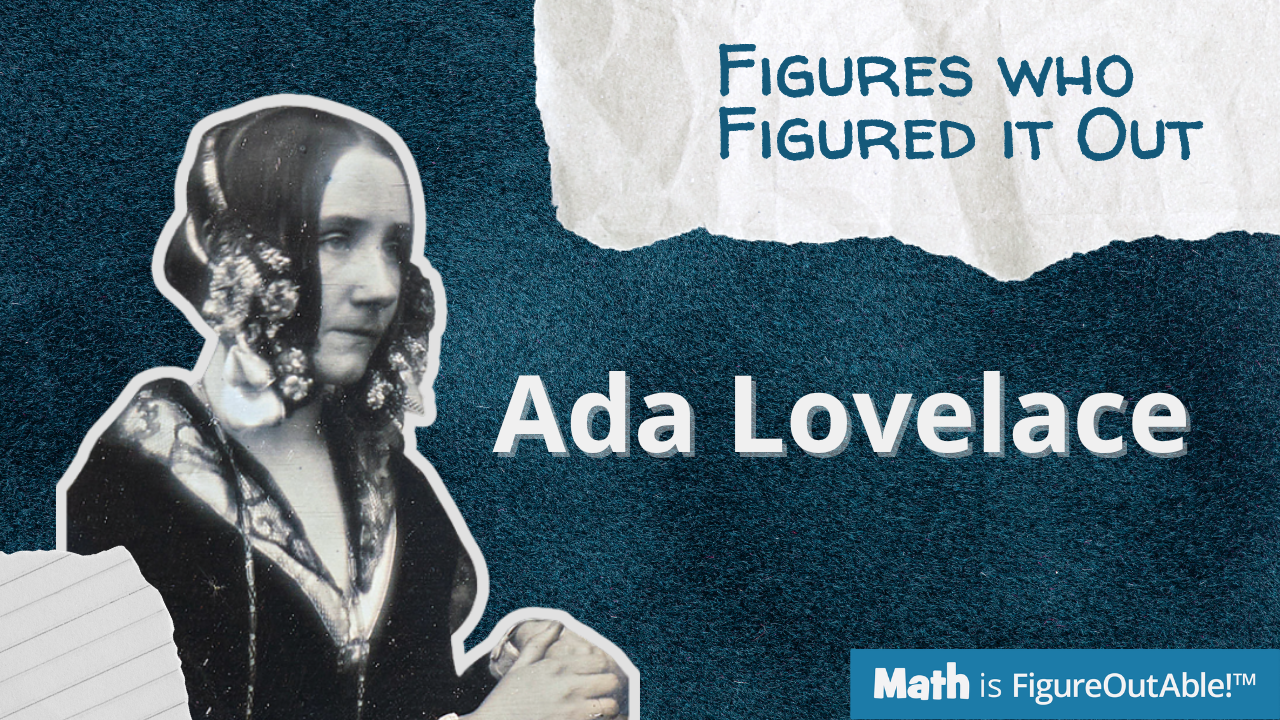
That's what Ada Lovelace did in 1843. She didn't just translate an article by Italian mathematician Luigi Menabrea about Charles Babbage's proposed Analytical Engine. She annotated it so thoroughly, tripling its length with her own insights, that her notes became one of the most complete descriptions of a general-purpose computer written in the 19th century.
She was 27 years old. The computer wouldn't be invented for another hundred years.
If you've ever been told that math is for certain kinds of people, or that imagination has nothing to do with mathematics, Ada Lovelace has something to say about that.
The Mathematician Who Saw What No One Else Could
Ada Lovelace lived in a world that had strong opinions about what women were capable of thinking, calculating, and contributing. She was expected to manage a household and a social calendar, not to spend her nights working through differential equations or corresponding with Europe's leading mathematicians.
She did both. And then she wrote something that wouldn't be fully understood for a century.
What makes Lovelace remarkable isn't just that she overcame the barriers placed in front of her. It's that she thought in ways that were so far ahead of her time that even her collaborator Charles Babbage didn't fully grasp what she was describing. She saw that a machine capable of manipulating symbols according to rules wasn't just a calculator. It was something fundamentally new. That insight is the foundation of every computer, phone, and piece of software in existence today.
From Dangerous Imagination to Mathematical Pioneer
Augusta Ada Byron was born on December 10, 1815, in London. Her father was the poet Lord Byron: famous, scandalous, and largely absent. He left when Ada was a month old, and her mother, Annabella, was determined that Ada would not inherit what she called her father's "poetical" temperament. Annabella believed that poetry led to madness, so she prescribed a strict regimen of mathematics and logic to keep Ada's imagination in check.
It didn't work. Or rather, it worked too well. Ada's imagination and her mathematical training fused into something neither parent had anticipated: a mind that could think rigorously about abstract ideas and see patterns and possibilities no one else noticed.
At 17, Ada met the mathematician and inventor Charles Babbage at a party and was shown his working model of the Difference Engine, a mechanical calculator. While other guests admired its gears and bells, Ada grasped the mathematical principles underneath it. Babbage was immediately struck by her understanding.
But formal mathematical education for women was nearly impossible to access. Ada worked largely through correspondence and private tutoring, most significantly with Augustus De Morgan, a professor of mathematics at University College London. He wrote to her mother that Ada's questions showed a mind capable of going "beyond the usual female limit" in mathematics, which was his era's awkward way of saying she was exceptional.
In 1835, Ada married William King, who later became the Earl of Lovelace, giving Ada the title by which she's remembered: Ada Lovelace. She continued studying mathematics through her twenties while raising three children, often working late into the night.
In 1842, an Italian mathematician named Luigi Menabrea attended a Babbage lecture and wrote an article about Babbage’s Analytical Engine in French. Babbage asked Lovelace to translate it into English. She didn't just translate it. She added her own notes, labeled A through G, that were more than twice as long as the original article.
Note G contained an algorithm for computing Bernoulli numbers using the Analytical Engine: a specific, step-by-step sequence of operations for a machine to follow. It is now recognized as the first published algorithm in history. More than the algorithm itself, Lovelace's notes articulated something Babbage had not. Because the Analytical Engine could manipulate any symbols according to rules, not just numerals, it could, in principle, compose music, produce graphics, or perform any operation that could be represented symbolically. This was the conceptual leap from calculator to computer.
She called this "the science of operations." We now call it computer science.
What Lovelace Figured Out: Contributions That Built the Digital World
She wrote the first published computer algorithm
Note G of her 1843 translation describes a precise sequence of steps for the Analytical Engine to calculate Bernoulli numbers, a complex series used in number theory. This was not a mathematical proof or a description; it was an operational procedure meant to be executed by a machine. That is what an algorithm is. Every piece of software ever written descends from this idea.
She articulated the concept of a general-purpose computer
Babbage saw his Analytical Engine as a very powerful calculator. Lovelace saw further. She understood that any process that could be expressed in rules and symbols could, in principle, be carried out by the machine, including processes that had nothing to do with numbers. She wrote explicitly that the Engine "might compose elaborate and scientific pieces of music of any degree of complexity or extent." She was describing what we now call a universal computer more than a century before one existed.
She identified the limits of computing, with equal clarity
Lovelace was also careful to note what such a machine could not do. It could only carry out what it was instructed to do. It could not originate ideas. This distinction between computation and cognition remains one of the central questions of artificial intelligence today. She drew the boundary in 1843.
She modeled what mathematical imagination looks like
Lovelace's approach to mathematics wasn't purely procedural. She described it as "poetical science": the idea that imagination is as essential to mathematics as rigor. She believed that seeing unexpected connections, asking "what if," and thinking beyond the given problem were not distractions from mathematical thinking. They were at its heart. Modern mathematicians would agree.
Try It Yourself: Think Like Lovelace
Lovelace wrote her algorithm as a sequence of steps: precise instructions that could be followed without ambiguity. That's the core of what an algorithm is.
The Challenge: Write an algorithm (a set of step-by-step instructions) for something you do every day. Making lunch, getting ready for the work day, or choosing what to wear. Make it precise enough that someone who has never done it before could follow it without asking any questions. A generalizable algorithm is more than just a set of instructions: it might involve different optionsRemember to allow for different options
Now think like Lovelace: When you write out each step, pay attention to the places where you had to make a decision. Those are the most interesting moments. Lovelace had to think carefully about how a machine would handle choices: what to do when a condition was true versus false. In modern programming, those are called conditionals (if/then/else).
Go further: Find a step in your algorithm that says something like "if it's raining, then..." or "repeat until..." Those are the building blocks of every computer program ever written, and Lovelace was the first person to work them out formally.
What you just learned: You wrote an algorithm. And if you found a place where a decision had to be made, you discovered why programming is genuinely hard and why it takes mathematical thinking, not just button-pressing. Lovelace saw all of this in a machine that hadn't been built yet.
The FigureOutAble Takeaway
Ada Lovelace's greatest lesson isn't that she was a hidden genius waiting to be discovered. It's that she combined two things people are often told don't go together, imagination and mathematical rigor, and refused to let anyone convince her that one had to cancel out the other.
Her mother tried to suppress her "poetical" nature with mathematics. What actually happened is that her imagination made her a better mathematician, and her mathematical training made her imagination more powerful.
Couldn't access university? She built her education through correspondence, tutors, and sheer determination. Expected to stop thinking seriously about mathematics after marriage and children? She worked through the night and produced the most important document in the history of computing. Surrounded by brilliant men who didn't quite see what she saw? She wrote it down anyway, in enough detail that the world eventually caught up.
When math feels too abstract, too removed from creativity, or like a subject that doesn't have room for imagination, remember Lovelace. She looked at a machine made of gears and brass and saw the internet.
If math was FigureOutAble for her, working by candlelight, without institutional support, a century ahead of her time, it is FigureOutAble for you. Not because the obstacles aren't real. But because your curiosity and your imagination are exactly the tools mathematics needs.
That's what mathy people do. They figure it out, no matter what.
Help Your Students Discover Their Inner Lovelace
Every student brings imagination to the table. The question is whether our math instruction invites it or shuts it down. When students are asked to make sense of ideas, not just follow procedures, they think like Lovelace. They connect, question, and see things others miss.
Math is FigureOutAble Solution supports teachers in building exactly that kind of classroom, where mathematical thinking is something every student does, not something a select few are born with.
Ready to guide the next Lovelace? Visit the Math is FigureOutAble Solution page to learn more and start a conversation about what support could look like in your school or district.
Because the world needs more people who believe math is FigureOutAble. Especially people who've been told their kind of mind doesn't belong in mathematics. And it starts with teachers like you.
Author

Pam Harris
Math Educator
Pam Harris is a mom, a former high school math teacher, a university lecturer, an author, and she wants to change the way we view and teach mathematics. While Pam was teaching high school math, her four children grew and mathematized their world in a way she had never imagined. “I had always bought into the myth that math is a disconnected set of facts to memorize, with rules and procedures to mimic. I now call that fake math.” Pam’s own kids, research, and experiences teaching real math have shown her what it means to mathematize and to support learners in their own journeys. Real math is thinking mathematically, not just mimicking what a teacher does on the board. You can shift your brain from using rote memory to mathematizing. Pam helps teachers make this shift for themselves, and helps teachers teach in a way that supports students to learn real math.
Stay connected with news and updates!
Categories
All Categories