Alan Turing: He Asked the Questions Nobody Else Thought to Ask
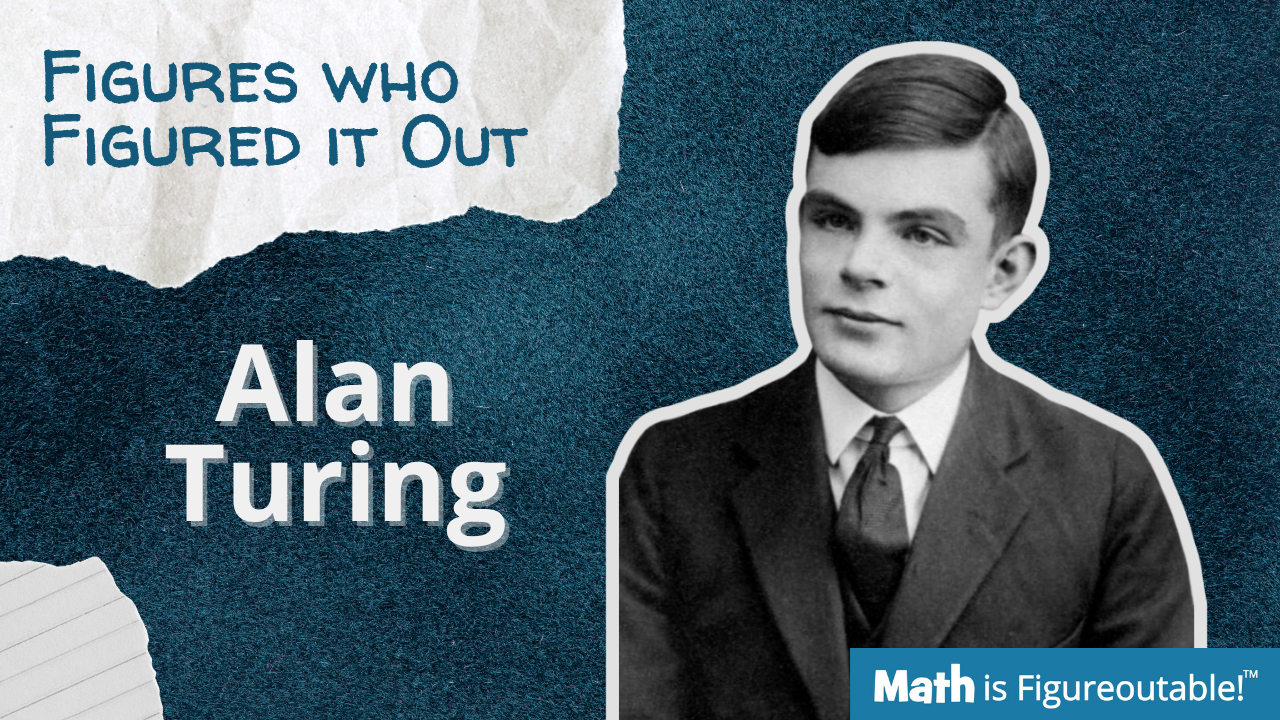
He Imagined a Machine That Could Solve Anything. Then He Built One to Help Win a War. Then the Country He Saved Prosecuted Him.
Written by the Math is FigureOutAble Team We're a team of educators and math thinkers who believe persistence, curiosity, and good teaching make math FigureOutAble for everyone.
The Father of Computer Science Who Never Saw a Personal Computer
This post is part of our Figures Who Figured It Out series, where we explore the lives of mathematicians whose stories remind us that math isn't about perfection or genius—it's about persistence, curiosity, and figuring things out.
Every time you tap on a keyboard, unlock your phone, or ask an AI a question, you are using a machine that exists because a series of people were willing to sit with a deeply abstract problem and reason toward an answer that changed everything. One of those people was Alan Turing.
His story is one of extraordinary intellectual courage, wartime heroism, and a devastating injustice that the world is still reckoning with. It is also, at its core, a story about what happens when someone refuses to accept that a problem is unsolvable.
A Boy Who Followed His Own Path
Alan Mathison Turing was born on June 23, 1912, in London. His father worked in the Indian Civil Service, which meant Alan and his older brother John spent much of their childhood being raised by family friends in England while their parents were abroad. It was a lonely start, and by many accounts Turing carried a certain self-contained quality throughout his life, someone who did his deepest thinking alone and on his own terms.
His schools, however, were not always sure what to make of him. When he arrived at Sherborne, one of England's prestigious boarding schools, his headmaster reportedly wrote that if Turing intended to be a specialist in science and mathematics, he was wasting his time there. The school prized classical languages and literature. An athletic runner, Turing was interested in chemistry, mathematics, and the kinds of questions nobody had asked yet.
He ignored the headmaster's opinion and kept thinking.
One bright spot in those years was a friendship with a fellow student named Christopher Morcom, the first person Turing had found who could really match him intellectually. The two worked through scientific problems together and Turing described the friendship as transformative. When Morcom died suddenly from tuberculosis in 1930, Turing was devastated. He channeled his grief into his work, writing later that he felt compelled to carry on thinking about the kinds of questions they had explored together.
He arrived in Cambridge in 1931 to study mathematics, and that is where everything began to open up.
The Machine That Existed Only on Paper
In 1936, at the age of 24, Turing published a paper that would become one of the most important documents in the history of mathematics and science. Its title was dry and technical: "On Computable Numbers, with an Application to the Entscheidungsproblem." What it contained was a template for all computing devices .
Mathematicians of the time were wrestling with a fundamental question: was there a definitive procedure, a mechanical method, that could determine whether any mathematical statement was provable or not? Turing answered the question in part by imagining a machine.
The Turing machine, as it came to be called, showed that, while there were some mathematical problems that were unsolvable, there were other problems that were solvable–and, crucially, all the solvable mathematical problems could be solved in principle by the same theoretical machine.
The Turing machine was a thought experiment: It consisted of an infinitely long strip of tape divided into squares, a reading head that could move along the tape one symbol at a time to the left or right, and a set of rules that told the head what to do based on what it read: read, write, or move. That is it. No gears, no circuits, nothing physical. Just a thought experiment about what it means to follow a procedure step by step.
Using this imaginary machine, Turing proved that no such universal decision method could exist. There are mathematical problems, he showed, that no machine, no matter how powerful, could ever solve. But in the process of proving that some problems were beyond the reach of a computer, he also invented the concept of the general-purpose computer, a machine that could be programmed to any computable problem or computation whatsoever.
Bletchley Park and the Code That Could Not Be Broken
When World War II began in 1939, Turing joined the Government Code and Cypher School at Bletchley Park, the secret British codebreaking center. The Germans were using a cipher machine called Enigma to encrypt their military communications. Messages were scrambled using a system of rotating wheels and electrical pathways that could produce an almost incomprehensible number of possible settings: roughly 159 quintillion combinations.
Breaking Enigma by hand was not just slow. It was effectively impossible.
Polish mathematicians, particularly Marian Rejewski, Jerzy Różycki, and Henryk Zygalski, had made critical early breakthroughs before the war and shared their methods with Britain. Even though he sometimes found it safer and easier to work alone, he learned to collaborate with a team of fellow British codebreakers. For example, he and mathematician Gordon Welchman developed a machine called the Bombe, which could work through possible Enigma settings at mechanical speed, dramatically narrowing the search for the correct configuration each day.
By 1940, the Bombes were decoding German Luftwaffe messages. By mid-1941, Turing and his team's statistical innovations had cracked the German naval codes as well. When the Germans later switched to an even more complex system, Turing developed techniques to break that too.
Historians estimate that the work at Bletchley Park shortened the war by two to four years and saved millions of lives. Turing was central to that effort. He received an OBE for his contributions. Because his work was classified under the Official Secrets Act, almost nobody outside Bletchley knew what he had done. He was a top secret hero.
Thinking Machines and the Question That Still Haunts Us
After the war, Turing turned his attention to a question that had been circling in his mind for years: could a machine think?
In 1950, he published a paper called "Computing Machinery and Intelligence," which opened with a sentence so direct it still stops readers cold: "I propose to consider the question, 'Can machines think?'" He then immediately set aside that question in favor of an imitation game that became known as the Turing Test: If a human could not reliably tell the difference between conversing by text with a machine and with a person, Turing argued, we would have good reason to say the machine was thinking.
That paper is considered a founding document of artificial intelligence as a field. The questions raised about machine consciousness, intelligence, and imitation are still actively debated today, in philosophy, computer science, and ethics.
Turing was also doing genuinely original work in mathematical biology during this period, developing equations to describe how patterns form in nature, how a leopard might get its spots, how a spiral emerges in a shell. He was ranging freely across disciplines, following curiosity wherever it led.
A Debt That Was Never Paid
After the war, despite everything he had contributed, Turing's life unraveled at the hands of the very government he had helped save. In 1952, he was prosecuted under a British law that criminalized his personal life and sexual orientation. He was convicted and subjected to a course of hormone injections that caused lasting physical and psychological harm. Even though, again, his team’s codebreaking likely ended the European war two to four years earlier, saving millions, he was stripped of his security clearance and barred from the work he had spent his career building.
An unsung war hero persecuted by his own state, he died on June 7, 1954, at the age of 41. A half-eaten apple was found by his bedside. The coroner ruled it as suicide by cyanide poisoning. Some researchers have since suggested the death may have been accidental; still others suspect foul play. Nobody knows for certain.
The British government issued a formal apology in 2009. Queen Elizabeth II granted a royal pardon in 2013. In 2021, Turing's face appeared on the UK's 50 pound note. In a 2019 BBC poll, the public voted him the greatest scientist of the twentieth century.
None of it could give back what was taken.
Try It Yourself: Think Like a Turing Machine
Turing's great insight was that any computation, no matter how complex, can be broken down into a sequence of very simple steps. Here is a way to feel that idea in action.
The Challenge: Suppose you need to add two numbers together, say 3 and 4, but you are only allowed to do one tiny thing at a time: move one step forward or backward on a number line, or keep track of a single count.
Try it: Start at 3 on a number line. Now, instead of just "adding 4," break it into the smallest possible steps. Move one step to the right. Now do it again. And again. And one more time.
What you find: 3, then 4, then 5, then 6, then 7. You have added 3 and 4 by doing nothing more than moving one step at a time, four times.
Now try this: Can you use the same tiny-step approach to figure out 5 times 3? Hint: think of multiplication as repeated steps of addition, and addition as repeated steps of moving one space.
What you just experienced: That is the logic of the Turing machine. Any calculation, from adding grocery totals to training an AI model, can ultimately be reduced to a sequence of very simple operations, each one completely mechanical. What makes computers powerful is not that any single step is clever. It is that they can follow billions of simple steps, perfectly and almost instantaneously. Turing figured that out with nothing more than a thought experiment and a strip of imaginary tape.
Stories like Turing's are exactly why we share this Figures Who Figured It Out series, because he did not wait for the technology to exist before he started reasoning about what it could do.
The FigureOutAble Takeaway
Alan Turing's greatest lesson is not about genius or specialness. It is about what becomes possible when someone is willing to reason from first principles and ask the questions everyone else has skipped past.
He did not accept that a problem was too hard. He did not accept that a code was unbreakable. He did not accept that a question about machine intelligence was too philosophical to tackle. He sat with hard problems, built careful reasoning, and figured things out.
And then there is the other lesson in his story. The one about what it costs a society when it fails the people who are quietly doing precisely this everyday yet heroic work of figuring out hard problems. Turing's mind gave the world the computer, helped win a world war, and planted the seeds of artificial intelligence. And yet the country he served stripped him of his ability to continue that work. We will never know what he would have figured out next.
The classroom matters. The culture matters. Every student who is made to feel like they do not belong in mathematics is a loss the world cannot afford.
That is what mathy people do. They figure it out. And they deserve a world that lets them.
Build the Classrooms Turing Never Had
Alan Turing had to do much of his most important thinking in isolation, in secret, and ultimately under conditions of profound injustice. Sometimes with teams and sometimes on his own, he figured many things out anyway. Imagine what he could have accomplished in a more collaborative and less hostile environment. It is how much more becomes possible when every student is genuinely welcomed into mathematical thinking.
Math is FigureOutAble Solution supports teachers in building that kind of classroom. Through differentiated professional learning, expert coaching, and practical tools for every experience level, Solution helps educators create the conditions where all students are expected to think, reason, and figure things out, not just follow procedures.
Ready to build the kind of math culture where every student gets a real invitation in? Visit the Math is FigureOutAble Solution page to learn more and schedule a conversation about what support could look like for your school or district.
Because the world needs more people who believe math is FigureOutAble. And it starts with teachers like you.
Author

Pam Harris
Math Educator
Pam Harris is a mom, a former high school math teacher, a university lecturer, an author, and she wants to change the way we view and teach mathematics. While Pam was teaching high school math, her four children grew and mathematized their world in a way she had never imagined. “I had always bought into the myth that math is a disconnected set of facts to memorize, with rules and procedures to mimic. I now call that fake math.” Pam’s own kids, research, and experiences teaching real math have shown her what it means to mathematize and to support learners in their own journeys. Real math is thinking mathematically, not just mimicking what a teacher does on the board. You can shift your brain from using rote memory to mathematizing. Pam helps teachers make this shift for themselves, and helps teachers teach in a way that supports students to learn real math.
Stay connected with news and updates!
Categories
All Categories