How a Borrowed Book Led to an Astronomy Pioneer
Written by the Math is FigureOutAble Team. We're a team of educators and math thinkers who believe persistence, curiosity, and good teaching make math FigureOutAble for everyone.
The Man Who Calculated His Way Into History
This post is part of our Figures Who Figured It Out series, where we explore the lives of mathematicians whose stories remind us that math isn't about perfection or genius. It's about persistence, curiosity, and figuring things out.
Imagine being born into a society that legally classified you as less than human, a society where it was illegal in many places to teach you to read, where your labor was considered property, and where virtually every institution of science and learning was closed to you. Now imagine that, against every one of those odds, you taught yourself advanced mathematics and astronomy, predicted solar eclipses with precision, helped survey the nation's capital, and published an almanac read across the country for over a decade.
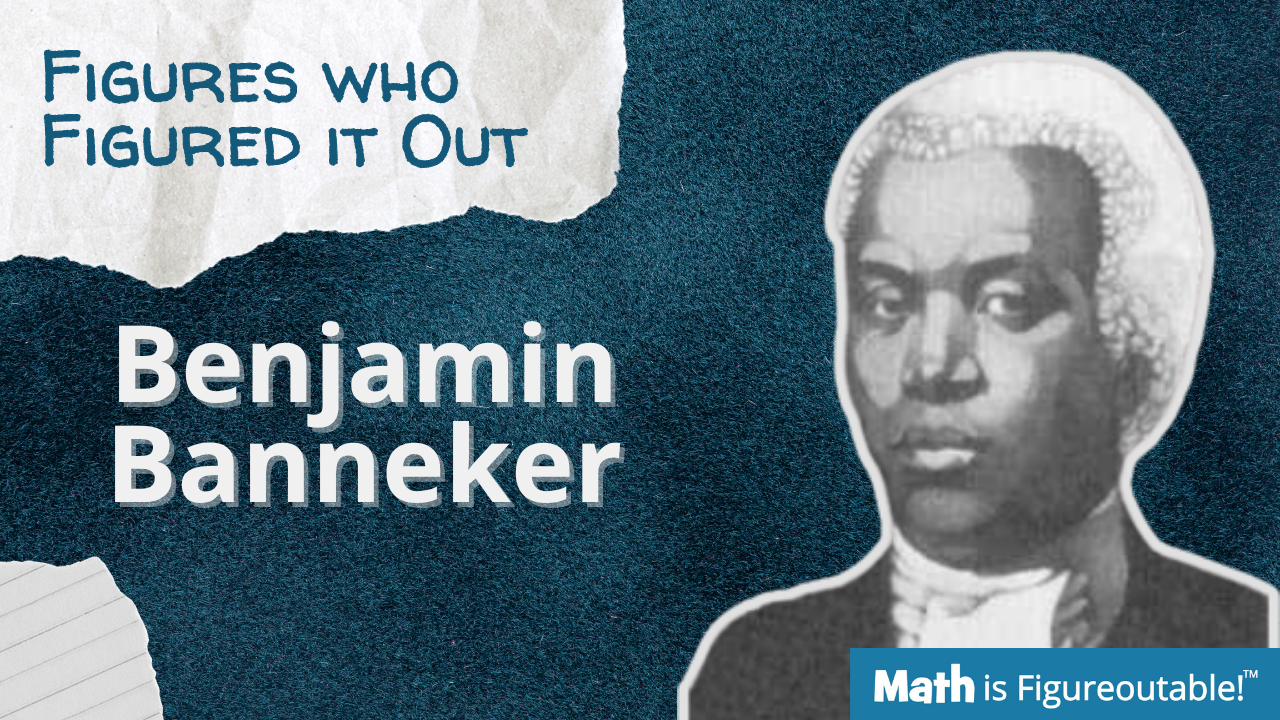
That's Benjamin Banneker. He did all of that within an environment designed to drag him down.
If you've ever felt like the system wasn't built for you, Banneker's story isn't just inspiring. It's a masterclass in what happens when curiosity refuses to quit.
The Mathematician Who Refused to Accept His Assigned Limits
Benjamin Banneker was a free Black man living in colonial and early-American Maryland—a time and place where his very existence defied the assumptions of nearly everyone around him. He had no university access, no formal training in mathematics or astronomy, and no network of colleagues to learn from. What he had was a mind that loved puzzles, a willingness to stay up through the night watching stars, and a determination to figure things out.
He did exactly that.
His astronomical calculations were accurate enough that his almanacs were sold from Maine to Kentucky. His work was cited in a landmark letter to Thomas Jefferson as living proof that Black people were fully capable of complex intellectual achievement. And his contributions to the survey of Washington, D.C., helped lay out a capital that still stands today.
From Tobacco Farm to the Stars
Benjamin Banneker was born on November 9, 1731, in Baltimore County, Maryland. His grandmother, Molly Welsh, was an Englishwoman who had come to Maryland as an indentured servant, eventually earned her freedom, and purchased and later freed two enslaved men, one of whom, Bannaky (from whom the family name comes), she married. Their daughter Mary married a formerly enslaved man named Robert, and together they had Benjamin.
Banneker grew up on the family's tobacco farm. His grandmother taught him to read using the Bible, one of his only books for most of his childhood. A nearby Quaker school briefly opened its doors to him, where he showed an early gift for mathematics. But formal schooling ended quickly, and Banneker returned to farm life.
What didn't end was his curiosity.
As a young man, Banneker encountered a pocket watch and became so fascinated by its mechanics that he borrowed it, disassembled it completely, sketched every gear and spring, reassembled it perfectly, and then, from memory and those sketches, carved an entire working clock out of wood. This was around 1753. His wooden clock kept accurate time for over forty years. He had never seen a clock made of anything but metal. He had no manual. He just... figured it out.
The Borrowed Book That Changed Everything
In 1788, when Banneker was 57 years old, his neighbor George Ellicott, a Quaker surveyor, lent him several books on astronomy along with a telescope and some drafting instruments. Ellicott expected to come back later and explain the material. He didn't need to.
By the time Ellicott returned, Banneker had not only taught himself the contents of those books but had already identified an error in one of them. Working by candlelight and firelight on the family farm, a man who had never formally studied astronomy began computing ephemerides, the precise daily positions of the sun, moon, and planets.
He also predicted solar and lunar eclipses. His first attempt, for 1791, differed from the published calculations of noted astronomers of the day, but when the eclipse happened, Banneker's prediction proved to be the accurate one.
In 1791, Banneker had his chance to contribute to something historic. Major Andrew Ellicott, George's cousin, was commissioned to survey the boundaries of the new Federal Territory, the area that would become Washington, D.C. He brought Banneker as his assistant. For several months, Banneker handled the astronomical clock, the celestial observations, and the precise calculations needed to run the survey.
From 1792 through 1797, Banneker published Benjamin Banneker's Pennsylvania, Delaware, Maryland and Virginia Almanac and Ephemeris, a remarkable annual publication filled with weather predictions, tide tables, medicinal remedies, and astronomical calculations he computed. The almanac sold tens of thousands of copies and made him widely known throughout the young United States.
In August 1791, Banneker wrote a letter to Secretary of State Thomas Jefferson, who had written extensively about the supposed intellectual inferiority of Black people, and included a copy of his manuscript almanac as evidence. He called out Jefferson's hypocrisy directly, noting that Jefferson held enslaved people while professing that “all men are created equal” and that the qualities he attributed to Black people as innate were the result of oppression, not nature. Jefferson wrote back expressing his hope that Banneker was right about black people, acknowledging the almanac and sending it to a contact in Paris. Whatever Jefferson privately believed, Banneker had put it on record: a self-taught Black mathematician was producing work of the highest quality.
What Banneker Figured Out: Contributions That Still Matter
He mastered astronomical calculation from scratch
The math behind an almanac isn't simple arithmetic. Predicting the position of planets and timing eclipses requires understanding orbital mechanics, trigonometry, and precise timekeeping, fields in which most educated men of the era had years of formal training. Banneker had a borrowed book and a wooden clock. He built the rest through grit and ingenuity.
He demonstrated what self-directed mathematical learning looks like
Banneker didn't wait for someone to teach him. He looked at the tools and resources available. A neighbor's books, the night sky, his own patient observation, and figured things out. He treated mathematical questions the way curious people always do: as puzzles worth solving, not barriers to give up at.
He provided a documented counter-argument to scientific racism
The idea that Black people were intellectually inferior was not a fringe opinion in 1791. It was actively cited by prominent figures to justify slavery. Banneker's almanac, his letter to Jefferson, and the subsequent correspondence became part of an early public record refuting those claims with irrefutable evidence. Organizations working to abolish slavery distributed his almanacs widely for exactly this reason.
He did all of this while running a farm
Banneker's astronomy was not a full-time research position. He was a working farmer who stayed up through cold Maryland nights making observations, then spent his days maintaining crops. He is the rare figure in mathematical history who did rigorous scientific work entirely outside any institution, without pay, recognition, or colleagues—because the work itself mattered to him.
Try It Yourself: Think Like Banneker
Here's a challenge inspired by how Banneker thought about patterns in the night sky.
The Challenge: Banneker needed to predict exactly when the moon would be in a certain position. He knew the moon completes a full cycle in approximately 29.5 days. If a full moon occurs on January 1st, when is the next full moon? The one after that? The one after that?
Now think like Banneker: Don't just add 29.5 days and stop there. Notice the pattern. The sequence of full moons follows a rule. That rule lets you predict far into the future without starting over each time.
Full moon dates from January 1:
- 1st full moon: January 1
- 2nd full moon: January 30 or 31 (+ 29.5 days)
- 3rd full moon: ?
- 10th full moon: ?
Banneker's insight: When you understand the underlying pattern—the rule that generates each term—you don't have to calculate from scratch every time. You can project forward. That's exactly how he was able to produce a full year of astronomical predictions in his almanac. He found the pattern, trusted it, and extended it.
Try this: Make a simple table tracking the full moon dates for the next 6 months from today. Can you identify any months where there might be two full moons? (Hint: when the cycle doesn't divide evenly into calendar months, something interesting happens.)
The FigureOutAble Takeaway
Banneker's story is extraordinary not because he overcame the odds, though he certainly did, but because of how he overcame them. He didn't wait for permission. He didn't wait for a teacher. He didn't accept the story that people like him couldn't do mathematics.
He found a book. He sat with it. He worked through what he didn't understand. He stayed up through the night watching the stars. And then he went back to his calculations.
Couldn't enroll in university? He borrowed books and taught himself. Had no colleagues to verify his work? He trusted his calculations and the eclipse proved him right. Society insisted he was incapable of complex thinking? He sent his manuscript almanac to the Secretary of State as Exhibit A.
Banneker's life is a reminder that mathematical thinking isn't the property of institutions, credentials, or people who've been told they belong. It belongs to anyone willing to be curious, to sit with a hard problem, and to keep figuring it out.
When math feels impossible, when you feel like you don't belong in mathematical spaces, when the obstacles seem too large, when the system seems designed to exclude you, remember that a self-taught farmer in 18th-century Maryland computed eclipse predictions accurate enough to correct published astronomers.
If math was FigureOutAble for Banneker under those conditions, it is FigureOutAble for you. Not because the obstacles aren't real. But because your curiosity, your persistence, and your willingness to figure it out are more powerful than the obstacles.
That's what mathy people do. They figure it out, no matter what.
Help Your Students Discover Their Inner Banneker
Every student can learn to think like a mathematician. They can sit with a hard problem, look for the pattern, trust their reasoning, and push through to understanding. They don't need perfect conditions or the right pedigree. They need teachers who believe in them and instruction that invites sense making.
Math is FigureOutAble Solution supports teachers in creating exactly that kind of classroom: where every student is expected to think, reason, and figure things out.
Ready to guide the next Banneker? Visit the Math is FigureOutAble Solution page to learn more and start a conversation about what support could look like in your school or district.
Because the world needs more people who believe math is FigureOutAble. Especially people who've been told they don't belong. And it starts with teachers like you.
Author

Pam Harris
Math Educator
Pam Harris is a mom, a former high school math teacher, a university lecturer, an author, and she wants to change the way we view and teach mathematics. While Pam was teaching high school math, her four children grew and mathematized their world in a way she had never imagined. “I had always bought into the myth that math is a disconnected set of facts to memorize, with rules and procedures to mimic. I now call that fake math.” Pam’s own kids, research, and experiences teaching real math have shown her what it means to mathematize and to support learners in their own journeys. Real math is thinking mathematically, not just mimicking what a teacher does on the board. You can shift your brain from using rote memory to mathematizing. Pam helps teachers make this shift for themselves, and helps teachers teach in a way that supports students to learn real math.
Stay connected with news and updates!
Categories
All Categories