Differentiating Problem Strings for Your Grade Level
Guest blog: Kim Montague, Math is FigureOutAble podcast co-host
Introduction: Why Problem Strings Matter
If you’re a veteran to the Math is FigureOutAble movement, you know that we are obsessed with high impact routines, and that Problem Strings top the list. We’ve chatted a lot over the years about how valuable Problem Strings are and have even more to unpack in this blog about episode 295 of the Math is FigureOutAble podcast.
If you are new to the Math is FigureOutAble movement, and to Problem Strings, dive right in to learn a bit about our favorite routine!
What are Problem Strings?
As we define it in the introduction to our Problem String books, a Problem String is an instructional routine that uses a series of related problems presented in a purposeful sequence to support students in developing visual, numeric, spatial, and operational relationships. The power of the Problem String lies in the guided class discussion and the purposeful representation of student thinking.
One of the best things about Problem Strings is that They. Are. For. Everyone.
Whether you teach 2nd grade, 6th grade, Calculus, or adult learners, Problem Strings are right for your students and the content you teach. Let’s focus on a particular strategy and how we think about adapting a Problem String sequence to address the needs of many different aged learners.
The "Over” Subtraction Strategy Explained
As you may have already heard on the podcast, the Remove a Friendly Number Over (“Over”) strategy is one of my favorites!
This strategy means that, given a subtraction problem, you remove a friendly amount larger than the subtrahend and then add back as needed—you subtract too much and then adjust. For example, given the problem 183 − 99, you might subtract 183 − 100 first to get 83, and then make an adjustment by adding one back, 83 + 1 = 84.

"The “Over” strategy makes use of the associative property, where 183 − 99 = 183 − (100 − 1). This is one of the more sophisticated subtraction strategies because it requires some anticipatory thinking—students begin with a 2-step plan in mind: remove a friendly amount and then adjust."
Place value is also strengthened as students deal with the magnitudes of the numbers in the problems and make jumps of friendly numbers—numbers that are multiples of 1, 10, 100, and 1000 (e.g., 83 − 39 = 83 − (40 − 1) = 43 + 1). Students as young as first grade can make use of the “Over” strategy for both addition and subtraction (e.g., 17 − 8 = 17 − (10 − 2) = 7 + 2).
Adult-ish Strings
On the podcast, Pam and I discussed an adult-ish “Over” string that we might plan for for our podcast listeners or for teachers in a workshop. We call them “adult-ish” because even though our students might be older, we know that differentiation is still crucial.
Adult-ish strings often start with smaller numbers and finish with decimals and fractions, so that teachers can see the particular strategy applied with the types of numbers they might be using with their students. To accomplish so much, these adult-ish strings are often much longer than we would facilitate with students.
Consider the following series of problems we discussed in episode 295.
- 16 − 10 and 16 − 9
- 37 − 20 and 37 − 19
- 462 − 100 and 462 − 95
- 6371 − 2000 and 6371 − 1988
- 5.2 − 2 and 5.2 − 1.9
- 2.63 − 1 and 2.63 − 0.97
- 19⅓ − 8 and 19⅓ − 7⅔
The string is arranged in a Helper-Clunker structure, meaning that for each pair of problems, the first might serve as a helper to solve the second, clunkier problem. Careful facilitation draws out the connection between the pair of problems, and expert modeling makes the thinking visible to all.
Since individual Problem Strings aren't one-size-fits-all, here’s how we’d adapt the string for different grade levels, and why!
Adapting for Each Grade Level
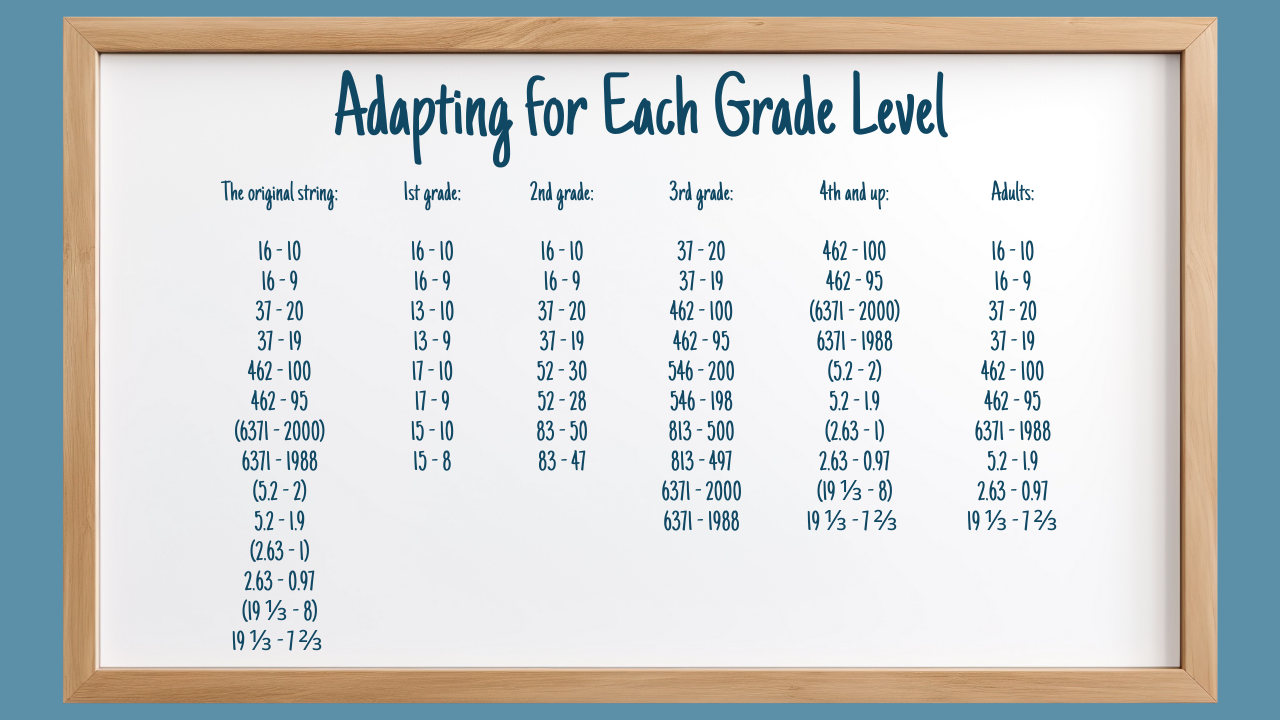
Consider the original string we discussed in episode 295. You might already be thinking about the need to cut some problems out for your grade level. What might you cut? What might you add? Check out the problems from the original string that we would keep for each grade level (blue) and how we would adapt the string by adding some problems in (black).
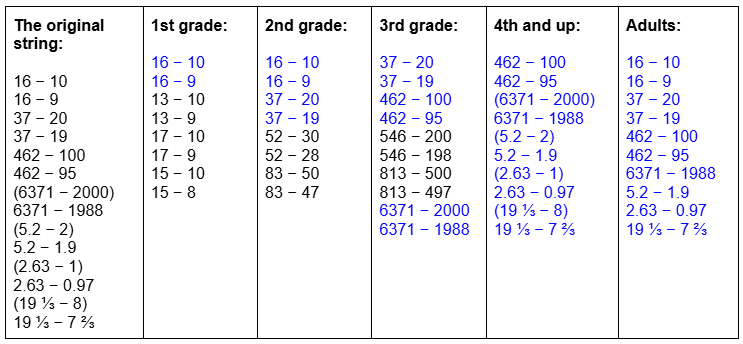 The original string: Notice the length of the string and the varied types of problems. Optional helper problems (in parentheses) are included in the list so that we can remember what helper we might be aiming for.
1st grade: First grade is the land of teens! The first pair is super for emphasizing the relationship of “ten and” in the helper problem and then using that relationship in the clunker. Rather than up the ante with the next pair of problems, we’d live in the land of teens throughout the whole string. Notice that we purposefully chose 16, 13, 17, and 15 as the minuend (first number) to give students experience with some of the more challenging facts! The last clunker then ups the ante by removing 8 rather than 9, just in case students are just rotely removing 10 and adding back one each time. A fun twist!
2nd grade: For second, we’d keep the first two pairs of problems for a softer entry. It’s a nice review of some subtraction facts, to start and then move to two digit minuends for the rest of the string. Notice that we would increase the magnitude of both numbers to give students experience subtracting multiple of tens. If we see many students needing to subtract one ten at a time that’s feedback, suggesting we need more work on Remove a Friendly Number. The final two clunkers require students to add back 2 or 3, so that they can start to generalize that Over isn't just good for numbers that end in 9.
3rd grade: Here’s an example of a string where we would ramp up more quickly. We’d want third graders to experience both Remove a Friendly Number and Remove to a Friendly Number prior to this strategy, so it’s not their first time messing with three-digit numbers. Here the clunker can get even further away from the friendly number! If students were using a traditional algorithm those clunkers would be pretty yucky! We included some four-digit numbers in the last pair to celebrate that this fantastic strategy makes problems that look bad actually easily solvable. Anyone want to play I Have, You Need for that final clunker?
4th and older: 4th-grade and older students solve subtraction problems of all kinds, so they need sophisticated strategies that last. The same is true for all the grades beyond elementary. As a former 4th and 5th teacher, I might have used a string like this as a revisit to the Over strategy—- perhaps when I saw students not consider it often, or when I wanted a chance to revisit decimal and fraction work. Notice that one of the decimal problems is tenths and the other is hundredths, providing an extra opportunity to discuss place value.
Adults: The original Problem String as written lists only blue problems, but be sure to notice that with adults very often we end with no helpers for the final four problems. Once learners understand the Over strategy at work, it’s time for them to apply what they have noticed by creating their own helper problems. This nudge is less likely used with students in their first Over Problem String, but with adults we can up the ante even in their first experience. “I wonder, what might a helper be for this clunker?” is a great way to differentiate for those who are ready.
Key Principles for Differentiation
As always, we believe in the mantra “Know Your Content, Know Your Kids”. As you hone your craft of Problem String facilitation and think about the students you are preparing for, you may choose to further adapt these strings or future strings you encounter.
A Few Considerations For Adaptation:
- What size numbers are appropriate for your grade level/students?
- How much experience have your students had with those size numbers?
- Is this the first time your students have encountered the strategy or is it a follow up, echo string?
- Are you looking for a next-step string that is just a bit of a nudge or a larger increase in challenge?
- Are you facilitating this string on a newer-to-them model or one they are familiar with?
- Are students ready to create their own Helper problems?
Closing: Take Your Problem Strings to the Next Level
We’ve chatted before on the podcast about how Pam and I facilitated expertly written Problem Strings long before writing our own strings. If you’re ready to dive in to teaching with strings, but aren’t sure you’re ready to consider the sequence of problems, the structure you’d choose, and the important facilitation moves—, we’ve got you covered!
You can get your own copy of pre-written Problem Strings to take the guesswork out of differentiating for your grade level here. We’ve given you the sequences of problems, sample dialogue, models we use, sequences of strings, PLUS plenty of tips so that you can do the hard work of focusing on your students. Keep making math figureoutable, friends!
Author

Pam Harris
Math Educator
Pam Harris is a mom, a former high school math teacher, a university lecturer, an author, and she wants to change the way we view and teach mathematics. While Pam was teaching high school math, her four children grew and mathematized their world in a way she had never imagined. “I had always bought into the myth that math is a disconnected set of facts to memorize, with rules and procedures to mimic. I now call that fake math.” Pam’s own kids, research, and experiences teaching real math have shown her what it means to mathematize and to support learners in their own journeys. Real math is thinking mathematically, not just mimicking what a teacher does on the board. You can shift your brain from using rote memory to mathematizing. Pam helps teachers make this shift for themselves, and helps teachers teach in a way that supports students to learn real math.
Stay connected with news and updates!
Categories
All Categories