Factor Puzzles: Helping Math Make Sense
Guest blog post by Susan Smith and Kourtney Peters, Math is Figureoutable team
Feeling Puzzle-y?
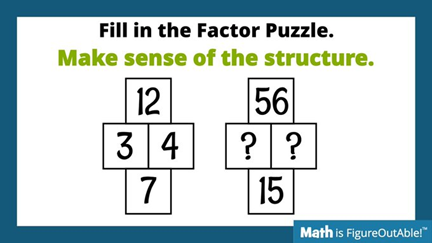
Take a look at the puzzle on the left.
What do you notice?
What do you wonder?
If you noticed that 3 x 4 gives you the product of 12, which is the number on top…
And you noticed that 3 + 4 sums to 7, which is the number on the bottom…
Congrats! You have figured out a Factor Puzzle.
And I bet when you glance at the puzzle on the right, your brain is already thinking about what number each “?” must be to maintain those same relationships.
Factor Puzzles can be addicting. And add great value to your classroom!
Anatomy of Factor Puzzles
Factor Puzzles are a routine we absolutely love. They are a fun and engaging way to build additive and multiplicative reasoning for any student grades three and up.
The puzzle is a set of 4 squares, arranged with one centered on top, two side-by-side in the middle, and one centered on the bottom. Imagine placing numbers within those squares, so that the top number is 30, the two side numbers are 5 and 6, and the bottom number is 11. Can you see any relationships between those numbers?
That’s the challenge we pose to students: What do you notice about the puzzle you see? What relationships pop out to you?
Once students understand the relationships, identifying the top number as a product, the bottom number as a sum, and the middle numbers as factors or addends, you can challenge students by providing some of the numbers and leaving others unknown for them to solve.
For example, you could give students:
- the product and sum, leaving them to grapple with determining the two middle numbers.
- the two middle numbers, asking them to calculate the top and bottom numbers.
- the product, sum, and one middle number, leaving students to find the one unknown middle number.
With each unknown to solve, students are asked to consider different relationships.
Let’s Talk Strategy
Imagine a Factor Puzzle with 24 at the top, 11 at the bottom, and both middle numbers unknown. A student could first think about all the factor pairs of 24; 1, 24 ; 2, 12 ; 3, 8 ; 4, 6, and then consider which two pairs add up to 11, arriving at the conclusion that the numbers must be 3 and 8 or 8 and 3.
Another student might think about all the numbers that add to 11 and which pairs have a product of 24. The preferred strategy to cultivate with students would be to find the factor pairs first, as there are always going to be fewer factor pairs to filter through than pairs of addends for a given sum. Rather than tell students, we prefer to give them multiple experiences and ask guiding questions to help them draw their own conclusions about efficiency.
Through solving Factor Puzzles, students connect addition and multiplication. They apply reasoning instead of guessing. The routine also builds structure awareness and quietly prepares students for algebra. If students experience this kind of thinking early, expressions later do not feel like a brand new language.
Another power of this routine is that it can be used with whole numbers, but also in higher grades integers and variables, which we will visit in the coming weeks!
Whole Number Factor Puzzle Problem String
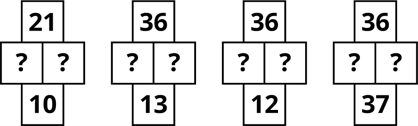
On episode 300 of the Math is Figureoutable podcast, we shared the following Problem String of Factor Puzzles. As with all Problem Strings, remember to present and discuss each problem one at a time building connections and strategies as you go. Try this string with your class and let us know how it goes!
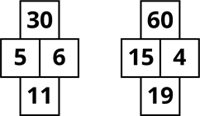
Present the first completed factor puzzle and ask, “What do you notice? What relationships pop out at you?” Once students have identified that the top number is the product of the middle two numbers, and the bottom number is the sum, present the next puzzle and ask, “Do the patterns still hold in this puzzle? How do you know?” Then present the first problem with unknowns.
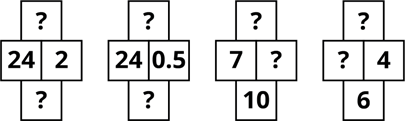
With each puzzle, possible questions include:
- “What do the given numbers make you think about?”
- “What relationship are you using to solve for the unknown number?”
- “Are you thinking about factors or addends first? Which do you think is more efficient?”
Factor Puzzles with Integers
Factor puzzles with integers give students a puzzle-like atmosphere to practice operations with integers. These puzzles can beautifully spark students to think and reason about sums and products of positive and negative numbers.
Because they are multiplying and adding in each factor puzzle, students have the opportunity to parse out the relationships. Students are high-dosed with these important patterns as they differentiate between when you're multiplying and when you're adding positive and negative numbers. It's about experiencing and pulling out those connections and relationships. Students are positioned to think about if the product is negative (or positive), what does that mean about the factors? And if the sum is negative (or positive), what does that mean about the addends? We want kids to have to simultaneously consider and fluidly move between additive and multiplicative reasoning with integers.
Along with the facilitation questions noted in the previous section for whole number factor puzzles, integer puzzles can strengthen students’ reasoning with these additional prompts:
“What are you thinking about when the product is positive?”
“What are you thinking about when the product is negative?”
“What are you thinking about when the sum is positive?”
“What are you thinking about when the sum is negative?”
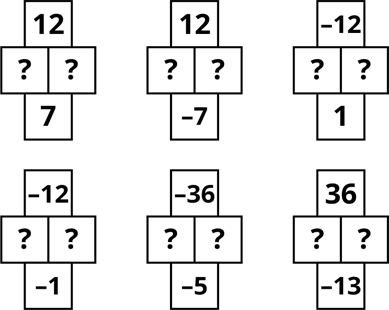
Another powerful feature of an integer Problem String is to choose a product and keep it a constant absolute value for a series of puzzles, allowing students to really focus on the integer component and all of the possible combinations. This gives students a lot of experience with not only that product, but with the shifts that occur with changing signs and the different thinking about the products versus the sums.
Once your students understand the structure of factor puzzles, add the puzzles to independent work or homework, or use a couple as a warm up or an exit ticket. Factor Puzzles are a very short routine to help students to keep thinking about integers and operations of integers.
On episode 301 of the Math is Figureoutable podcast, we shared the following Problem String of Integer Factor Puzzles. As with all Problem Strings, remember to present and discuss each problem one at a time building connections and strategies as you go. Try this string with your class and let us know how it goes!
Factor Puzzles with Expressions
Factor puzzles with variable expressions invite students to think about the relationship between addition and multiplication in a new way. With these factor puzzles, students gain experience parsing out the differences between, for example, x2, 2x, and (2+x). These experiences help build comfort with the symbolic representations of variables as well as the larger relationships.
When working with integers in factor puzzles, students often realize that the most efficient strategy usually means starting with the factor pairs of the given product, considering which factor pair will add to the desired sum. In these factor puzzles, where each sum and product includes a variable, sometimes it may be more helpful to focus on the sum at first, while nearly-simultaneously thinking about what the product will need to look like.
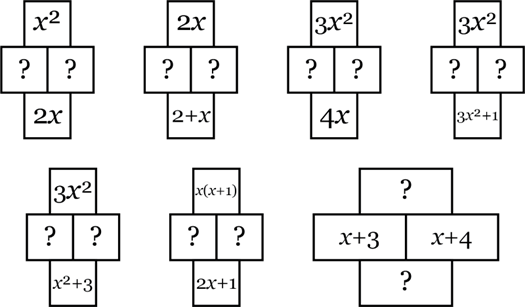
Consider, for example, a puzzle where the product given is 6x3: the factors could be 2x and 3x2 or 6x2 and x or 6x3 and 1 or 3 and 2x3, among many others! That feels like a lot of options to focus on! However, if the sum in the same puzzle is 2x3+3, the given addends 2x3 and 3 provide a great starting point to consider. This consideration of strategy when variables are involved is a great discussion to have with students!
It’s not that we want students to always start with either the product or the sum. We want students to develop flexibility within additive and multiplicative thinking enough that they can fluidly move between considering sum and product, eventually even nearly-simultaneously considering the products and sums. For example, if the sum is an x term and the product is an x2 term, what does that mean about the missing two expressions, and why?
Along with the facilitation questions noted in the previous sections for whole number and expression factor puzzles, factor puzzles with expressions can strengthen students’ reasoning with these additional prompts:
- What does x2 mean? What might it mean if the product has an x2 term in it?
- How is x2 different from 2x?
- How is 2x different from x+2?
- Which do you think is easier to start thinking about with this one, the product or the sum? Why?
On episode 302 of the Math is FigureOutAble podcast, we shared the following Problem String of Expressions Factor Puzzles. As with all Problem Strings, remember to present and discuss each problem one at a time building connections and strategies as you go. Try this string with your class and let us know how it goes!
Because Great Teaching Deserves Great Problems
First, thank you. If you are a listener of the Math is FigureOutAble podcast, we are so grateful you spend your time thinking deeply about math with us. And if you are not a listener yet, this is your invitation to start. It's where we dig into these ideas in real time, share what we're learning, and bring you the kinds of problems worth bringing back to your classroom.
If you're nodding along to this post, you already know something important: students are capable of deep thinking. The question is whether the math experiences we give them consistently build relationships, structure, and flexibility over time.
That kind of growth doesn't come from isolated lessons or random worksheets. It comes from intentionally sequenced problems, the kind where ideas build on each other and students have repeated opportunities to notice patterns, test strategies, and sharpen their thinking.
Factor Puzzles are a great place to start. Try the problem string with your class this week, use the resources below, and come back and tell us how it went. We'd love to hear what your students noticed.
Helpful Resources:
Author

Pam Harris
Math Educator
Pam Harris is a mom, a former high school math teacher, a university lecturer, an author, and she wants to change the way we view and teach mathematics. While Pam was teaching high school math, her four children grew and mathematized their world in a way she had never imagined. “I had always bought into the myth that math is a disconnected set of facts to memorize, with rules and procedures to mimic. I now call that fake math.” Pam’s own kids, research, and experiences teaching real math have shown her what it means to mathematize and to support learners in their own journeys. Real math is thinking mathematically, not just mimicking what a teacher does on the board. You can shift your brain from using rote memory to mathematizing. Pam helps teachers make this shift for themselves, and helps teachers teach in a way that supports students to learn real math.
Stay connected with news and updates!
Categories
All Categories