She Was the Ancient World's Greatest Math Teacher. Her Students Traveled from Across the Empire to Learn from Her.
Written by the Math is FigureOutAble Team We're a team of educators and math thinkers who believe persistence, curiosity, and good teaching make math FigureOutAble for everyone.
A Perfect Figure for Classical Education Month
September is Classical Education Month, a time to celebrate the enduring power of ancient ideas and the thinkers who shaped how humans understand the world. There is no more fitting mathematician to honor than Hypatia of Alexandria: the most celebrated female scholar of the ancient world, a woman who taught mathematics, astronomy, and philosophy, and whose story reminds us that the drive to figure things out is as old as human curiosity itself.
This post is part of our Figures Who Figured It Out series, where we explore the lives of mathematicians whose stories remind us that math isn't about perfection or genius. It's about persistence, curiosity, and figuring things out.
The Teacher Whose Classroom Was the Ancient World
Imagine being so respected as a mathematician and teacher that students travel hundreds of miles on foot and by sea, from across the Roman Empire, just to sit in your classroom. Imagine that civic leaders seek your advice on matters of science and governance. Imagine that your letters are preserved and treasured not because of who you were related to or married to, but because of the quality of your thinking.
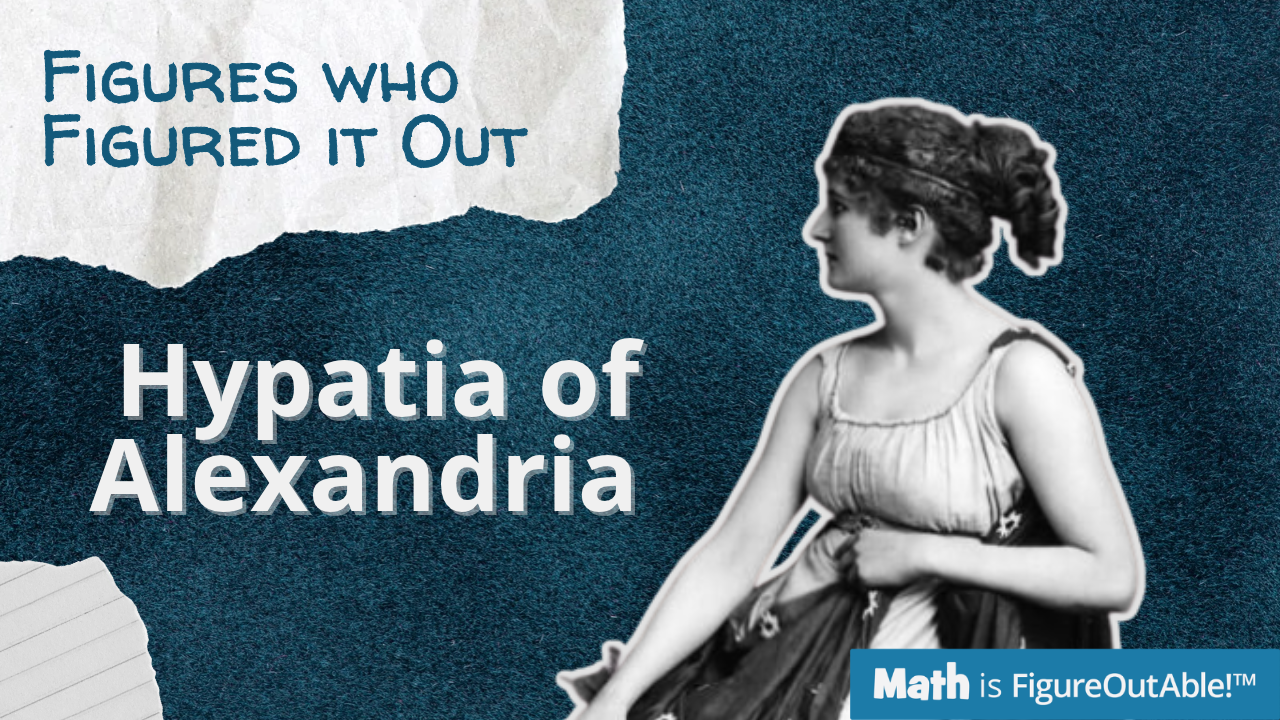
That was Hypatia of Alexandria, living and teaching in Egypt around 400 CE. In a world with strong ideas about what women could and couldn't contribute intellectually, she became the head of the Platonist school in Alexandria, one of the most important centers of learning in the ancient world. Students wrote letters home describing her with awe. City officials consulted her. She was, by any measure, the most prominent mathematician and philosopher of her era.
And she got there by doing mathematics. By teaching it with unusual clarity. And by refusing to be anything other than exactly what she was.
From Student to the Greatest Teacher in Alexandria
Hypatia was born around 360 CE in Alexandria, Egypt, then part of the Roman Empire. Her father, Theon of Alexandria, was himself a respected mathematician and astronomer, a scholar at the famous Museum of Alexandria (the institution connected to the legendary Library). He educated Hypatia himself, and by all accounts he did so with unusual intentionality. A later account suggests Theon was determined to raise "a perfect human being."
Whatever his method, it worked. Hypatia surpassed her father. She studied mathematics, astronomy, and Neoplatonic philosophy, eventually traveling to Athens to deepen her education further. When she returned to Alexandria, she began teaching, and her reputation grew quickly. She attracted students from across the Mediterranean world, many of them wealthy and influential, some of them pagan, some Christian, united by their hunger to learn from the best mind in the city.
What made her exceptional as a teacher wasn't just what she knew. It was how she taught. Her students' surviving letters describe someone who made difficult ideas accessible, who connected mathematics to philosophy and to the observable world, and who created in her classroom a sense that understanding was genuinely within reach. Sound familiar? Hypatia was, in the deepest sense, a teacher who believed thinking was figureoutable.
She was also a public intellectual. The Roman prefect Orestes, who governed Alexandria, was among her close associates. She advised him on matters involving the city. She was, in other words, someone whose mathematical and philosophical training was treated as genuinely useful for navigating the real world, not as an ornament or a curiosity.
In 415 CE, Hypatia was killed by a mob in one of the ancient world's most notorious acts of violence against a scholar. She was roughly 55 years old. The circumstances were entangled with political conflict between Orestes and the city's bishop, Cyril, and her association with Orestes made her a target. Her death sent shockwaves through the scholarly world and marked a turning point for the intellectual culture of Alexandria.
She left no complete works of her own. What survives of her contributions comes through the works she edited and annotated, and through the letters of her students.
What Hypatia Figured Out: Contributions That Shaped Mathematics
She made difficult mathematics teachable
Hypatia's most significant surviving contributions are her commentaries and edited editions of major mathematical texts. She worked with her father on a revised edition of Euclid's Elements, the foundational geometry text that students still encounter today. She wrote a commentary on Apollonius of Perga's Conics, a demanding work on the mathematics of conic sections (the curves you get when you slice a cone: circles, ellipses, parabolas, and hyperbolas). She also wrote a commentary on the Arithmetica of Diophantus, an early work in algebra.
These weren't passive transcriptions. Ancient commentaries were acts of mathematical teaching: clarifying proofs, adding explanatory examples, correcting errors, and making the ideas accessible to students who hadn't had the benefit of a direct teacher. Hypatia's versions of these texts became the ones that survived and were copied, which means her editorial and pedagogical choices shaped which mathematical ideas made it through the ancient world into the medieval period and eventually to us.
In a very real sense, Hypatia is part of why we still have Euclid.
She applied mathematics to the physical world
Hypatia and her father worked on astronomical calculations and instruments. She is credited with contributing to the design of an astrolabe, a device for measuring the positions of stars and planets, and of a hydrometer, an instrument for measuring the density of liquids. She understood mathematics not as an abstraction sealed off from the physical world, but as a set of tools for understanding it. Her students describe her explaining the movements of heavenly bodies with the same clarity she brought to abstract proofs.
She embodied the connection between mathematics and philosophy
Hypatia taught in the Neoplatonic tradition, which held that mathematics was not merely useful but was a path toward understanding deeper truths about reality. For her students, working through a geometric proof wasn't just a technical exercise. It was a way of training the mind to see clearly. This integration of mathematical rigor with broader questions of meaning and understanding is something modern math education is rediscovering: that mathematics, at its best, is a way of thinking, not just a set of procedures.
Try It Yourself: Think Like Hypatia
Hypatia taught conic sections, the family of curves you get by slicing a cone at different angles. Let's explore one of them.
The Challenge: Take a piece of paper and a pencil. Mark one point near the center of the page. That's your focus. Now mark a straight line across the lower third of the page. That's your directrix. A parabola is the set of all points that are exactly the same distance from the focus as they are from the directrix.
Pick three or four points that satisfy that rule and mark them. Connect the dots. What shape do you get?
Now think like Hypatia: She wasn't just computing curves. She was asking why those curves behave the way they do. A parabolic shape focuses all incoming parallel rays to a single point. That's why satellite dishes, telescope mirrors, and car headlights all use parabolic shapes. The mathematics describes something real.
Go further: Can you find a cone in your home or school? Think about the arc of a basketball, the shape of a flashlight beam on a wall when you tilt the flashlight, or the curve of a suspension bridge cable. Where else does this ancient mathematics show up in the modern world?
What you just learned: You constructed a conic section from its definition, exactly the kind of thinking Hypatia made accessible for her students in Alexandria. Geometry isn't just shapes on a page. It's the hidden structure of the physical world.
The FigureOutAble Takeaway
Hypatia's story carries a particular resonance during Classical Education Month, because she is living proof that the questions at the heart of classical learning, questions about the nature of truth, about how the mind works, about the relationship between mathematics and reality, are not dusty museum pieces. They are alive. They matter. And they were being pursued with extraordinary rigor by a woman teacher in Alexandria sixteen centuries ago.
Hypatia faced barriers we can barely imagine. She lived in a world where almost no written record of a woman's intellectual life was preserved. She navigated political tensions that ultimately cost her life. She had no institutional protection, no professional guild, no formal title beyond the one her students and peers gave her through their respect.
She taught anyway. She figured things out anyway. And the works she clarified and preserved outlasted the empire she lived in.
When math feels like it comes from somewhere distant, from geniuses in the past who are nothing like you, remember that one of the greatest mathematical teachers in human history was a woman who built her reputation entirely on the quality of her thinking and the clarity of her teaching. Driven by curiosity, and rigor, she discovered the deep satisfaction of understanding things clearly enough to help others understand them too.
That's what mathy people do. They figure it out, no matter what.
Help Your Students Connect to the Classical Roots of Mathematics
This Classical Education Month, consider sharing Hypatia's story with your students as a reminder that the mathematics they are learning has deep human roots. Euclid's geometry, the conic sections Hypatia taught, the arithmetic Diophantus explored: these are not arbitrary school subjects. They are part of a long human conversation about how the world works, a conversation Hypatia helped keep alive.
Math is FigureOutAble Solution supports teachers in building classrooms where students experience mathematics as meaningful, connected, and within reach, not as a set of rules handed down from somewhere unreachable.
Ready to guide the next Hypatia? Visit the Math is FigureOutAble Solution page to learn more and start a conversation about what support could look like in your school or district.
Because the world needs more people who believe math is FigureOutAble. Especially people who've been told the great thinkers don't look like them. And it starts with teachers like you.
Author

Pam Harris
Math Educator
Pam Harris is a mom, a former high school math teacher, a university lecturer, an author, and she wants to change the way we view and teach mathematics. While Pam was teaching high school math, her four children grew and mathematized their world in a way she had never imagined. “I had always bought into the myth that math is a disconnected set of facts to memorize, with rules and procedures to mimic. I now call that fake math.” Pam’s own kids, research, and experiences teaching real math have shown her what it means to mathematize and to support learners in their own journeys. Real math is thinking mathematically, not just mimicking what a teacher does on the board. You can shift your brain from using rote memory to mathematizing. Pam helps teachers make this shift for themselves, and helps teachers teach in a way that supports students to learn real math.
Stay connected with news and updates!
Categories
All Categories