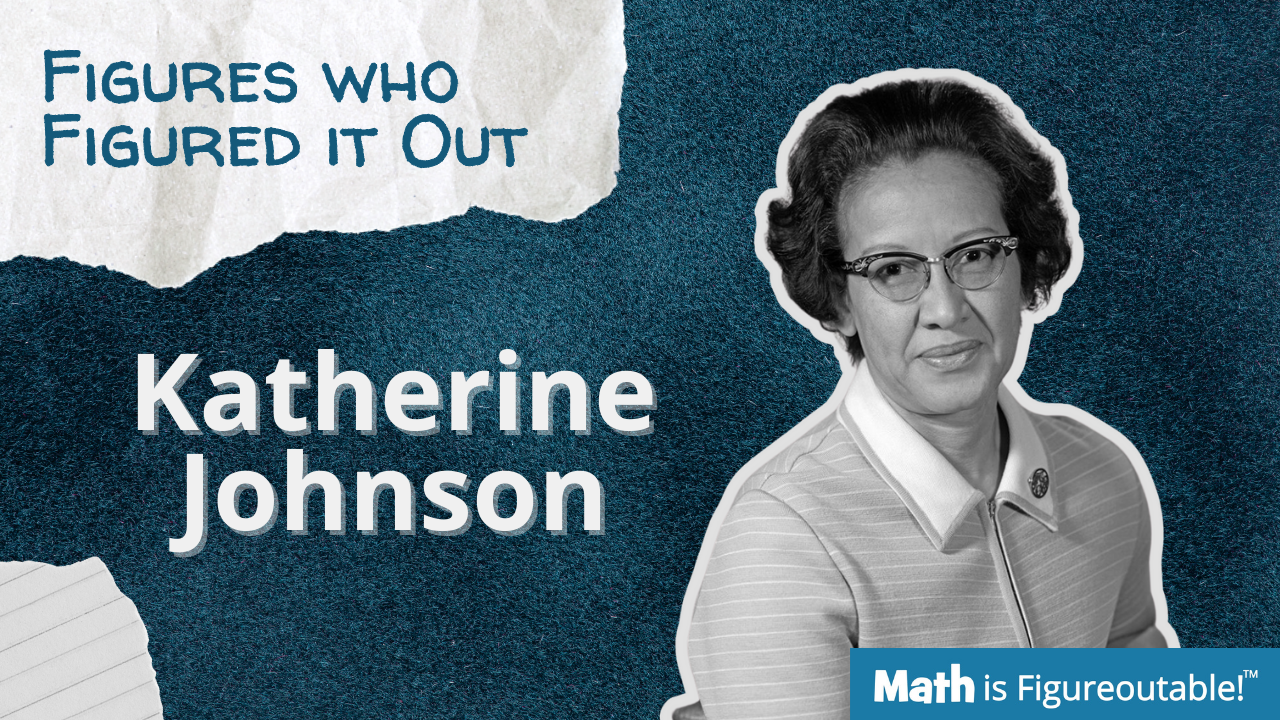
Katherine Johnson: The Human Computer Who Reached the Moon
She Counted Everything. Then She Counted Us Into Space
Written by the Math is FigureOutAble Team
We're a team of educators and math thinkers who believe persistence, curiosity, and good teaching make math FigureOutAble for everyone.
"Get the Girl to Check the Numbers"
Picture this: It's 1962. Astronaut John Glenn is preparing to become the first American to orbit Earth. NASA has these newfangled IBM computers doing the calculations for his trajectory. But Glenn isn't ready to bet his life on a machine.
He picks up the phone and makes a request that would echo through history: "Get the girl to check the numbers."
The "girl" he's talking about? Katherine Johnson, a 44-year-old African-American mathematician working at NASA's Langley Research Center. And according to author Margot Lee Shetterly, Glenn told engineers if Johnson said the numbers were good, he was ready to go.
Johnson ran the same calculations the IBM computers did by hand on her desktop mechanical calculator. Her math matched the IBM's. Glenn flew. He orbited Earth three times and returned safely. And that moment (an astronaut trusting a Black woman's hand calculations over a room-sized computer) became legendary.
If you've ever doubted your ability to do math because of who you are or where you come from, Katherine Johnson's story will change your perspective.
The Girl Who Counted Everything
Katherine Johnson loved to count from the very beginning: "I counted everything. I counted the steps to the road, the steps up to church, the number of dishes and silverware I washed … anything that could be counted, I did."
Born in White Sulphur Springs, West Virginia in 1918, Katherine Coleman (her maiden name) showed her mathematical brilliance early. By age 10, she was in high school. Most kids that age are in fourth or fifth grade. By 15, she'd started college. At 18, she graduated summa cum laude from West Virginia State College with degrees in Mathematics and French.
Her childhood wasn't easy. She grew up in an era when schools for African Americans in her town stopped at eighth grade. Her father, a farmer and janitor, had to drive the family 120 miles to Institute, West Virginia, so Katherine could continue her education. He believed in her that much.
At West Virginia State College, she met Professor William Claytor, who would change her life. Claytor, the third African American to earn a Ph.D. in Mathematics, created a special class in analytic geometry of space just for her. Years later, Johnson recalled: "Professor Claytor made sure I was prepared to be a research mathematician."
From Teacher to "Computer Who Wore Skirts"
After college, Johnson did what many brilliant women of her era did. She taught. She married, had three daughters, and put her own ambitions on hold. But in 1952, everything changed when a relative told her about an opportunity: The National Advisory Committee for Aeronautics (NACA, NASA's predecessor) was hiring African-American women to work as mathematical "computers."
In the 1950s, before electronic computers as we know them, "computers" were people. Mostly women. They performed complex mathematical calculations. Johnson later referred to the women in the computing pool as "computers who wore skirts".
She applied immediately. In June 1953, she joined the West Area Computing section at Langley, working in a segregated group led by Dorothy Vaughan. But Johnson didn't stay in the computing pool for long. Just two weeks into her job, she was assigned to the Flight Research Division, and her temporary position quickly became permanent.
What set Johnson apart? She asked questions.
"The women did what they were told to do," she explained. "They didn't ask questions or take the task any further. I asked questions; I wanted to know why." She talked her way into editorial meetings where no women had gone before. She refused to accept limitations based on her race or gender.
And when her husband James died of a brain tumor in 1956, leaving her with three young daughters, she didn't quit. She kept working, kept calculating, kept pushing forward.
Breaking Barriers, One Calculation at a Time
In 1958, NACA became NASA and officially ended segregation at its facilities. But changing policies on paper didn't instantly change hearts and minds. Johnson still faced discrimination. Women weren't allowed to put their names on research reports. Johnson became the first woman in her division to have her name on a published report, and she had to fight for it.
The report she co-authored with engineer Ted Skopinski was titled "Determination of Azimuth Angle at Burnout for Placing a Satellite Over a Selected Earth Position." This report turned out to be groundbreaking work on orbital spaceflight that would prove essential for future missions.
Johnson's passion was geometry, which turned out to be perfect for calculating spacecraft trajectories. When NASA prepared for the 1961 Mercury mission with Alan Shepard (America's first astronaut in space), Johnson knew the trajectory would follow a parabola, a type of symmetrical curve. She told NASA, "You tell me when you want it and where you want it to land, and I'll do it backwards and tell you when to take off".
She did exactly that. Shepard's flight was a success, and Johnson's calculations were flawless.
The Math That Got Us to the Moon
But Johnson's crowning achievement was still to come. In 1962, President John F. Kennedy charged the nation to send a man to the moon. Johnson became part of the team working on the Apollo program.
When asked to name her greatest contribution to space exploration, Johnson would talk about the calculations that helped synchronize the Apollo Lunar Module with the lunar-orbiting Command and Service Module. This was extraordinarily complex work: figuring out how to have one spacecraft rendezvous with another while both are orbiting the moon.
On July 20, 1969, Neil Armstrong and Buzz Aldrin walked on the moon. On July 24, all three Apollo 11 astronauts returned safely to Earth. Johnson's mathematics made it possible.
She continued working on the Space Shuttle program and the Earth Resources Satellite, authoring or co-authoring 26 research reports over her career. She retired from NASA in 1986 after 33 years, saying "I loved going to work every single day".
Why It Matters Today
Katherine Johnson lived to see her story celebrated. The 2016 book and film "Hidden Figures" brought her contributions (and those of her colleagues Dorothy Vaughan and Mary Jackson) into the spotlight. In 2015, President Barack Obama awarded her the Presidential Medal of Freedom, America's highest civilian honor. In 2016, NASA dedicated the Katherine G. Johnson Computational Research Facility at Langley Research Center in her honor.
Administrator Charles Bolden said it perfectly at the Medal of Freedom ceremony: "She's one of the greatest minds ever to grace our agency or our country, and because of the trail she blazed, young Americans like my granddaughters can pursue their own dreams without a feeling of inferiority."
Katherine Johnson passed away on February 24, 2020, at the age of 101.
Her legacy lives on in every woman and person of color working in STEM today. Every time a spacecraft launches, every time students of all backgrounds walk into advanced math classes, every time someone defies expectations about who belongs in mathematics, Katherine Johnson's impact reverberates.
Try It Yourself: Thinking Like Katherine
Here's a problem inspired by Johnson's work with trajectories. You can explore it right now with basic math:
The Challenge: If you throw a ball at an angle of 45 degrees, it follows a parabolic path. The ball will travel the same horizontal distance whether you throw it at 30 degrees or 60 degrees (assuming the same initial speed). Why?
Try it:
Imagine that the two parabolas shown here represent two balls thrown from the same place with the same initial velocity. Why do these parabolas meet where they meet? What conditions are needed to make them cross the x-axis at the same point?
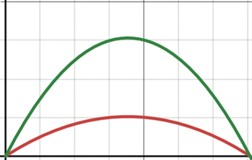
Katherine's insight: This is about complementary angles and symmetry. A launch angle and its complement (angles that add up to 90°) produce the same range because of how gravity and initial velocity components balance out. The steeper angle gives more time in the air but less horizontal speed; the shallower angle gives more horizontal speed but less time in the air. They balance perfectly.
What you just learned: If you are thinking that the balls represented by the parabolas above need to be thrown with the same initial velocity but at angle trajectories that are complementary to each other, you are using the same geometric thinking Katherine Johnson used to calculate spacecraft trajectories! When she worked on Alan Shepard's flight, she was working with parabolic paths just like this, only with much more complex equations accounting for Earth's rotation, gravity, and atmosphere.
This is exactly how Katherine approached problems: by understanding the fundamental geometry and physics, then building up to the complex calculations.
The FigureOutAble Takeaway
Katherine Johnson's story isn't just about being brilliant (though she absolutely was). It's about persistence in the face of barriers that should never have existed.
She grew up in a time and place that tried to limit her education because of her race. She worked in a field that tried to limit her contributions because of her gender. She faced colleagues who wouldn't let her put her name on her own work. She lost her first husband and had to raise three daughters while working a demanding job.
She kept going. She kept asking questions. She kept calculating. And she changed the world.
Johnson proved that mathematical ability has nothing to do with race or gender and everything to do with curiosity, determination, and the willingness to keep figuring things out. She showed that when you love what you do, when you refuse to be limited by others' narrow expectations, and when you persist through obstacles, you can literally reach the moon.
When you're struggling with a math problem and it feels impossible (maybe because someone suggested people like you aren't "math people," or because you're facing obstacles that have nothing to do with your ability), remember Katherine Johnson. Remember that she counted the steps to church as a little girl and ended up calculating the path to the Moon. Remember that an astronaut bet his life on her calculations because he knew her work was impeccable, regardless of her race or gender.
If math was FigureOutAble for her in a world that told her she didn't belong, it's FigureOutAble for you too. Not because you need to be a genius, but because you're willing to count everything, ask why, and keep calculating.
That's what mathy people do. They figure it out.
Help Your Students Discover Their Inner Katherine Johnson
Every student has the potential to think like a mathematician: to ask questions, persist through challenges, and discover the joy of figuring things out. They don't need to see themselves represented in every textbook photo to know they belong in mathematics. They just need teachers who believe in them and show them that math is FigureOutAble.
At Math is FigureOutAble, we help teachers create classrooms where all students (regardless of their background, race, or gender) develop the curiosity, resilience, and problem-solving mindset that defined Katherine Johnson's approach. We provide professional development, resources, and strategies that transform "I'm not a math person" into "I figured it out!"
Ready to guide the next Katherine Johnson? Whether you're looking to strengthen your math instruction, build student confidence, or create a culture where every student knows they belong in mathematics, we're here to help.
Learn more about our programs and resources to explore how Math is FigureOutAble can support your teaching journey.
Because the world needs more people who believe math is FigureOutAble, and it starts with teachers like you.
Author
Pam Harris
Math Educator
Pam Harris is a mom, a former high school math teacher, a university lecturer, an author, and she wants to change the way we view and teach mathematics. While Pam was teaching high school math, her four children grew and mathematized their world in a way she had never imagined. “I had always bought into the myth that math is a disconnected set of facts to memorize, with rules and procedures to mimic. I now call that fake math.” Pam’s own kids, research, and experiences teaching real math have shown her what it means to mathematize and to support learners in their own journeys. Real math is thinking mathematically, not just mimicking what a teacher does on the board. You can shift your brain from using rote memory to mathematizing. Pam helps teachers make this shift for themselves, and helps teachers teach in a way that supports students to learn real math.
Stay connected with news and updates!
Categories
All Categories