Leonhard Euler: The Blind Mathematician Who Saw Everything
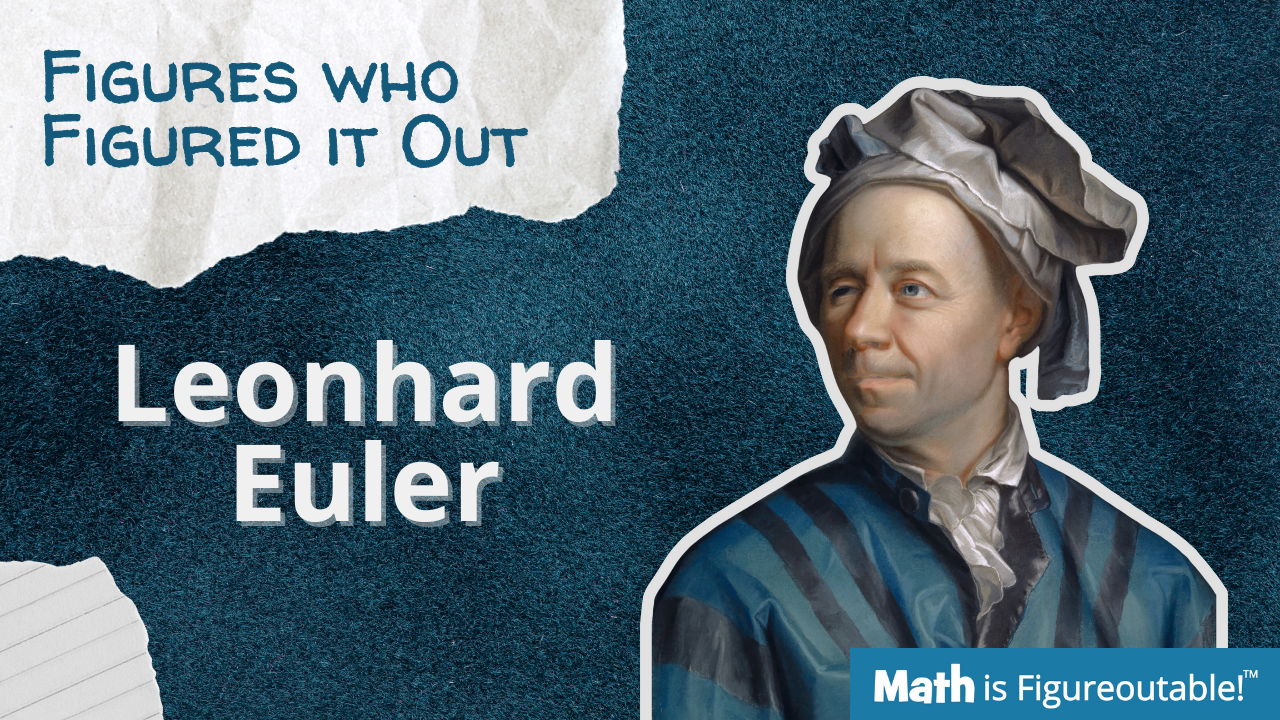
Leonhard Euler: The Blind Mathematician Who Saw Everything
He Lost His Vision and Became More Productive: Here's What That Teaches Us About Math
Written by the Math is FigureOutAble Team
We’re a team of educators and math thinkers who believe persistence, curiosity, and good teaching make math FigureOutAble for everyone.
The Man Who Died Doing Math
This post is part of our Figures Who Figured It Out series, where we explore the lives of mathematicians whose stories remind us that math isn’t about perfection or genius—it’s about persistence, curiosity, and figuring things out.
Imagine losing your sight and responding by doing more mathematics, not less. Most of us would panic. Leonhard Euler wrote 500 more papers.
When Euler went completely blind in 1771, he didn’t slow down. He sped up. He dictated groundbreaking work to his assistants, calculated complex equations in his head, and continued revolutionizing mathematics until his final day, when he literally died while doing math. In the middle of a calculation about the orbit of Uranus, he said, “I am dying,” and was gone.
If you’ve ever thought you can’t do math because conditions aren’t perfect, Euler’s story might just change your mind.
The Mathematician Who Worked with Babies on His Lap
Euler had 13 children, though only five survived to adulthood. Legend says he often did his most brilliant work with his young children playing at his feet, focused despite the inevitable interruptions and distractions. While many of his colleagues needed perfect silence and solitude, Euler figured out the mathematics of planetary motion with toddlers climbing on him.
He once solved a problem that stumped other mathematicians for months, and he did it in three days while nearly blind and suffering from a fever. When asked how he managed it, he reportedly said it was "obvious."
From Pastor's Son to Mathematical Giant
Born in Basel, Switzerland in 1707, Leonhard Euler (pronounced "OY-ler," not "YOU-ler") was the son of a pastor who expected him to join the clergy. Young Leonhard had other plans. At the University of Basel, he caught the attention of Johann Bernoulli, one of the leading mathematicians of the era, who recognized Euler's extraordinary talent and tutored him privately.
By age 19, Euler was already publishing original mathematical research. At 20, he joined the St. Petersburg Academy of Sciences in Russia, beginning a career that would span institutions in Russia and Germany and produced more published work than any mathematician in history.
Euler worked constantly. He thought about math so much that when it came time to write official papers, they poured out of him. Even when political upheaval forced him to flee between countries, even when he lost sight in one eye from strain, even when his house burned down destroying years of work, he kept mathing.
His personality? By all accounts, he was kind, generous with his time, and remarkably humble despite being the greatest mathematician of his generation. He helped other mathematicians with their work, tutored students patiently, and never flaunted his genius.
What Euler Figured Out: Contributions That Changed Mathematics Forever
Where do we even start? Euler contributed to virtually every area of mathematics known in his time, with 866 publications that are being collected in the Opera Omnia Leonhard Euler. If you stacked his published papers up, they'd be taller than a grown adult.
The most beautiful equation in mathematics: e^(iπ) + 1 = 0
This is Euler's Identity, and in a 1990 poll by The Mathematical Intelligencer, it was named the "most beautiful theorem in mathematics." It connects five of the most important numbers in mathematics in one simple statement: e (the base of natural logarithms), i (the imaginary number -1), π (pi), 1, and 0. Stanford professor Keith Devlin compared it to a Shakespearean sonnet that "reaches down into the very depths of existence." It's like the mathematics version of a perfect poem.
He invented graph theory by solving the Seven Bridges of Königsberg problem. The puzzle asked: Could you walk through the city of Königsberg by crossing each of its seven bridges exactly once? Euler proved it was impossible, and his work was presented to the St. Petersburg Academy on August 26, 1735 and published in 1741. But more importantly, he created a whole new way of thinking about problems using vertices (nodes) and edges, sparking a new branch of mathematics called graph theory. Today, this approach powers everything from GPS navigation to social network analysis to package delivery routes. Isn’t it amazing that a fun thought experiment that branched out of curiosity and a thirst for puzzles ended up holding the key to technological advancement?
Notation we use every day: That f(x) you see in algebra? Euler invented that. The symbol e for the mathematical constant? Euler. The use of π for pi in equations? Euler popularized it. The symbol i for imaginary numbers? Also Euler. The Σ (sigma) notation for summation? You guessed it: Euler. He didn't just do mathematics; he gave us the language we still use to write it.
He revolutionized calculus, making it more systematic and powerful. He developed the calculus of variations, which helps us find the "best" solution to problems. Like the strongest shape for a beam or the most efficient curve for a roller coaster.
He transformed physics and engineering by applying mathematics to mechanics, fluid dynamics, optics, and astronomy. His work helped explain how planets move, how ships sail, how lenses focus light, and how vibrating strings produce sound.
And remarkably, after Euler returned to St. Petersburg at age 59, he produced almost half of his total works despite being totally blind.
Why It Matters Today
Look around you. Euler's mathematics is everywhere.
Your smartphone? The image compression that lets you store thousands of photos uses Fourier analysis—built on Euler's groundbreaking work. The signal processing that transmits your voice during calls? Euler's formulas. The algorithms that route your data through networks? Graph theory, which Euler founded.
Engineering and architecture? When engineers calculate whether a building can withstand wind or earthquakes, they're using Euler's equations for structural stability. The Euler buckling formula determines whether a column will hold or collapse, critical for everything from skyscrapers to bridges to the legs of your chair.
Navigation and space travel? GPS satellites use equations Euler developed for celestial mechanics. When NASA calculates spacecraft trajectories, they're using mathematical methods Euler pioneered.
Finance and economics? The mathematics of compound interest, from your savings account to retirement planning, uses e, the number Euler studied extensively.
Even fields Euler never imagined, computer graphics, medical imaging, climate modeling, machine learning, rely on mathematical tools he developed 250 years ago.
Try It Yourself: Euler's Handshake Problem
Here's a puzzle Euler would have loved, and you can explore it right now:
The Challenge: At a party with 6 people, is it possible for each person to shake hands with exactly 3 other people?
Try it: Draw 6 dots on paper (representing people). Try connecting each dot to exactly 3 others with lines (representing handshakes). Can you do it?
Euler's insight: This is actually a graph theory problem! Each "dot" (vertex) needs exactly 3 connections (edges). For this to work, the total number of connections must be even (because each handshake requires two people). With 6 people each making 3 handshakes, that's 6 × 3 = 18, which is even. You can think of it as 18 hands are shaken, with 9 handshakes total. Try it. You'll find it works!
Now try this: Can 5 people each shake hands with exactly 3 others? (Hint: How many handshakes happen when each of 5 people shake hands with 3 people? Don’t forget that when two people shake hands, it’s only one handshake! Hint 2: A half of a handshakes is not possible!)
What you just learned: You used Euler's method of turning a real-world problem into dots and lines, then using mathematical reasoning to find the answer. This is exactly how Euler solved the Seven Bridges problem, and how computer scientists solve routing problems today.
Stories like Euler’s are exactly why we’re sharing this Figures Who Figured It Out series, because these mathematicians weren’t defined by ideal conditions, but by their willingness to keep figuring things out.
The FigureOutAble Takeaway
Euler's greatest lesson isn't about being a genius. It's about persistence, adaptability, and finding ways to keep figuring things out no matter what obstacles appear.
He lost his eye? He kept working. Lost his vision entirely? He said "Now I will have fewer distractions" and developed mental techniques to calculate without seeing, trained assistants to be his hands and eyes, and produced his most prolific work during his blind years. Lost his home in a fire? He reconstructed his research from memory.
Euler proved that mathematical thinking isn't about perfect conditions or even perfect abilities, it's about curiosity, determination, and the willingness to figure things out step by step.
When you're struggling with a math problem and conditions aren't ideal. Maybe you're tired, or distracted, or the concept seems impossibly hard. Remember Euler. He figured out the mathematics that powers our modern world while blind, in political upheaval, with children climbing on him.
If math was FigureOutAble for him under those conditions, it can be FigureOutAble for you too. Not because you need to be a genius, but because you're willing to persist, adapt, and keep figuring it out.
That's what mathy people do. They figure it out.
Help Your Students Discover Their Inner Euler
Every student can learn to think like a mathematician. They can persist through challenges, adjust their thinking, and experience the satisfaction of figuring something out. They do not need perfect conditions or special talent. They need instruction that invites sense making and builds confidence over time.
Math is FigureOutAble Solution supports teachers in creating that kind of classroom. Through professional learning, practical resources, and ongoing support, Solution helps strengthen instruction and build a culture where students are expected to think, reason, and figure things out.
Ready to guide the next Euler? Whether you want to strengthen math instruction, build student confidence, or create a culture of mathematical thinking in your classroom, Math is FigureOutAble Solution can help.
Visit the Math is FigureOutAble Solution page to learn more and schedule a conversation about what support could look like for your school or district.
Because the world needs more people who believe math is FigureOutAble. And it starts with teachers like you.
Author

Pam Harris
Math Educator
Pam Harris is a mom, a former high school math teacher, a university lecturer, an author, and she wants to change the way we view and teach mathematics. While Pam was teaching high school math, her four children grew and mathematized their world in a way she had never imagined. “I had always bought into the myth that math is a disconnected set of facts to memorize, with rules and procedures to mimic. I now call that fake math.” Pam’s own kids, research, and experiences teaching real math have shown her what it means to mathematize and to support learners in their own journeys. Real math is thinking mathematically, not just mimicking what a teacher does on the board. You can shift your brain from using rote memory to mathematizing. Pam helps teachers make this shift for themselves, and helps teachers teach in a way that supports students to learn real math.
Stay connected with news and updates!
Categories
All Categories