Maryam Mirzakhani: The Girl Who Wanted to Read Every Book in the World
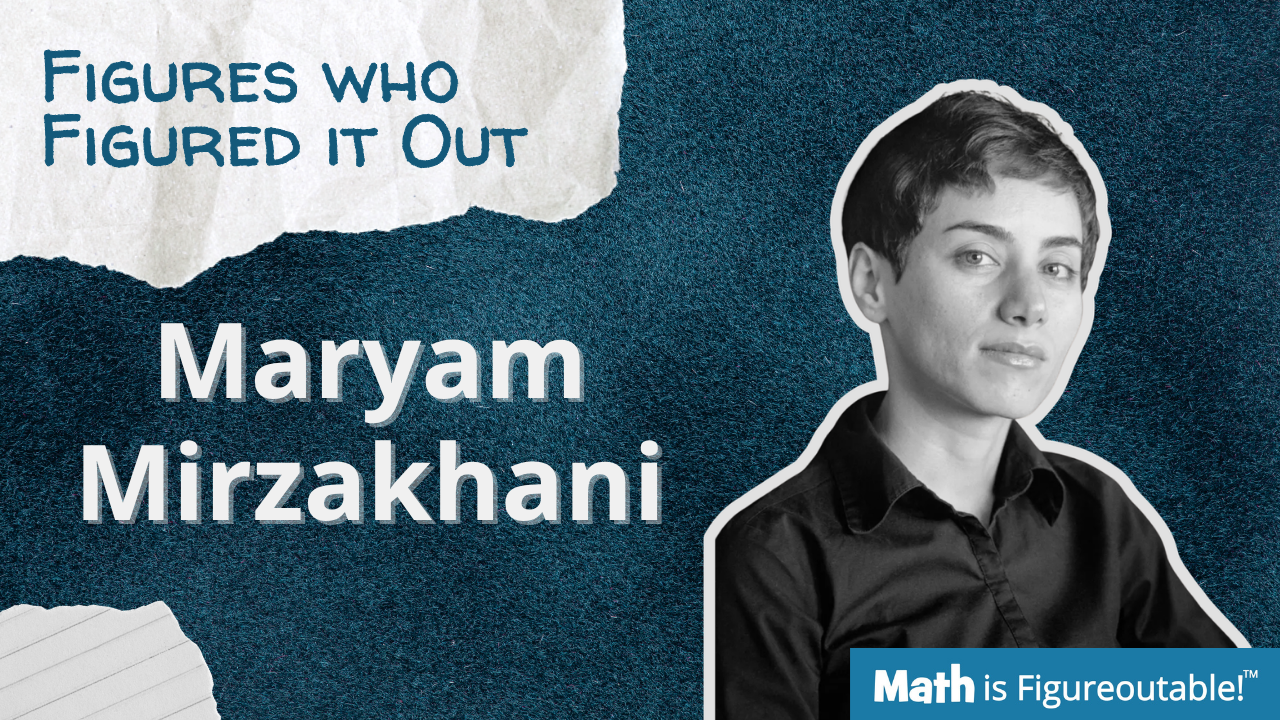
She Grew Up Wanting to Be a Writer. She Became the Greatest Mathematician of Her Generation.
Written by the Math is FigureOutAble Team We're a team of educators and math thinkers who believe persistence, curiosity, and good teaching make math FigureOutAble for everyone.
The First Woman to Win the Equivalent of the Nobel Prize of Mathematics
This post is part of our Figures Who Figured It Out series, where we explore the lives of mathematicians whose stories remind us that math isn't about perfection or genius—it's about persistence, curiosity, and figuring things out.
As a little girl growing up in Tehran, Maryam Mirzakhani had one goal: to read every book she could find. She wanted to be a writer. Mathematics was not part of the plan.
Then a teacher told her she was not good at math. And a series of lucky breaks, stubborn curiosity, and sheer persistence sent her on a completely different path—one that ended with her becoming the first woman in history to win the Fields Medal, the highest honor in mathematics.
She was 40 years old when she died. The world of mathematics is still absorbing what she left behind.
A Childhood Full of Stories
Maryam Mirzakhani was born on May 12, 1977, in Tehran, Iran. By her own account, she was a voracious reader from an early age, devouring novels and biographies and dreaming of a life built around stories. She watched television programs about Marie Curie and Helen Keller. She read a novel about Vincent van Gogh. She wanted to do something great with her life, though she was not yet sure what that looked like.
She finished elementary school just as the Iran-Iraq war was winding down, at a moment when opportunities were beginning to open for motivated students in Iran. She tested into the Farzanegan middle school for girls in Tehran, a selective school run by Iran's National Organization for Development of Exceptional Talents. It was a school full of ambitious, curious young women, and it changed her life.
But mathematics did not come easily at first. In her first year of middle school, she did poorly enough in math that she concluded she simply was not “a math person.” Her teacher's reaction did not help. The story of how a teacher's low expectations nearly redirected a once-in-a-generation mathematical mind into a different field entirely is worth sitting with for a moment.
The Friend Who Changed Everything
What turned things around was not a magical teacher or a perfect curriculum. It was a friend.
Mirzakhani's close friend encouraged her to try out for the mathematics olympiad team. Mirzakhani was skeptical. She did not think of herself as a math person. But she tried anyway, and something shifted. She started working on competition problems not as exercises to complete but as puzzles to genuinely figure out. She began to fall in love with the process of reasoning through a hard problem, not knowing where it would lead, and eventually finding a way through.
By her junior year of high school, she had made the Iranian Mathematical Olympiad team. In 1994, she traveled to Hong Kong for the International Mathematical Olympiad and won a gold medal, scoring 41 out of 42 points, the first Iranian woman to do so. The following year in Toronto, she scored a perfect 42 out of 42, becoming the first Iranian student ever to achieve a perfect score at the IMO and winning her second gold medal.
She was not always fast. She was not always first. She described herself throughout her life as a "slow" mathematician, someone who needed to sit with problems and turn them over carefully before the insight came. That quality, patience with difficulty, was not a weakness. It was the engine of everything she would accomplish.
Harvard, Hyperbolic Surfaces, and Thinking Like a Painter
After earning her undergraduate degree at Sharif University of Technology in Tehran, Mirzakhani moved to the United States to pursue her PhD at Harvard, studying under Curtis McMullen, himself a Fields Medal winner.
Her dissertation was extraordinary. She worked on hyperbolic geometry, the study of surfaces where the normal rules of flat space no longer apply. On a hyperbolic surface, triangles have angles that add up to less than 180 degrees. Unlike on a flat surface, given a line and a point not on that line, there are infinitely many lines through the point that are parallel to that line. On a hyperbolic surface, the shortest paths between two points, called geodesics, look from the outside like curved arcs and not straight lines.
Mirzakhani found ways to calculate the number of certain kinds of paths on these surfaces. Her dissertation solved several deep problems and resulted in three papers published in the top journals in mathematics, an almost unheard-of output from a single PhD thesis.
What made her approach unusual was not just mathematics but the way she worked. She spread large sheets of paper on the floor and covered them with drawings and doodles and formulas, working through ideas visually and spatially. Her daughter once described watching her mother work and said it looked like she was painting. Mirzakhani herself described mathematical research as being like getting lost in a jungle: you use everything you know, you try new tricks, and with some patience and some luck, you find a way out.
She was not memorizing paths through the jungle. She was figuring out how to navigate.
The Fields Medal and a Historic Moment
In 2014, at the International Congress of Mathematicians in Seoul, South Korea, Maryam Mirzakhani was awarded the Fields Medal. The citation honored her work on the dynamics and geometry of Riemann surfaces and their moduli spaces.
She was the first woman to win the Fields Medal in its 78-year history. She was also the first Iranian.
The announcement traveled around the world. In Iran, newspapers ran her photograph on their front pages, something notable in a country where women's images in public spaces are tightly regulated. For many young girls in Iran and across the world, the image of Mirzakhani holding that medal was the first time they had seen someone who looked like them at the very top of mathematics.
Mirzakhani herself was characteristically humble about the historic nature of the achievement. She said she was certain there would be many more women winning the award in the years ahead. She was eager to get back to her research.
She had already been diagnosed with breast cancer the year before.
What She Left Behind
Mirzakhani continued working through her illness. The cancer spread to her bones and liver, and she died on July 14, 2017, at Stanford Hospital in California. She was 40 years old, at what colleagues described as the peak of her creativity.
The loss to mathematics was immeasurable. But what she left behind is remarkable.
Her work on the "magic wand theorem," completed with collaborator Alex Eskin, showed that certain geometric structures are far more orderly and regular than anyone had expected. The implications of that work are still unfolding. Her techniques and tools have become foundational for researchers across geometry, topology, and dynamical systems.
And then there is her legacy beyond mathematics itself. May 12, her birthday, has been designated World Women in Mathematics Day by the International Mathematical Union. The Maryam Mirzakhani New Frontiers Prize was established to honor early-career women mathematicians each year. Scholarships, streets, and an asteroid have been named in her honor. The documentary Secrets of the Surface tells her story for new audiences.
She did not want to be the face of women in mathematics. She became one anyway, and in the best possible way: by simply doing extraordinary work and refusing to let anyone else's low expectations define what she was capable of.
Try It Yourself: Exploring Curved Space
Mirzakhani spent her career thinking about what happens to geometry when surfaces curve. Here is a way to get a small taste of that kind of thinking right now.
The Challenge: Draw a triangle on a flat piece of paper. Measure the three angles and add them up. You will get 180 degrees, or very close to it. That is how triangles work in flat space.
Now imagine drawing a triangle on the outside of a ball or orange. Pick three points on the surface. Connect them with the shortest possible path along the surface (not cutting through the inside). Measure those angles.
What you find: The angles add up to more than 180 degrees on a curved surface like a sphere. If you drew a triangle from the North Pole down to and across part of the equator then back up to the North Pole, each corner at the equator would be 90 degrees on their own, so when you include the angle at the North Pole the total would exceed 180 degrees. Three angles, all 90 degrees or more, adding up to more than 180.
Now flip it: On a hyperbolic surface, the kind Mirzakhani studied, triangles have angles that add up to less than 180 degrees. The surface curves the other way, like a saddle or a ruffled leaf.
What you just explored: The rules of geometry are not universal. They depend on the shape of the space you are working in. Mirzakhani devoted her life to understanding curved spaces, the paths that live on them, and the surprising regularities that emerge when you look carefully. That willingness to question whether the rules you learned in flat-space geometry are really the whole story is exactly the kind of mathematical thinking she modeled.
Stories like Mirzakhani's are exactly why we share this Figures Who Figured It Out series, because she was not defined by a teacher's early doubts about her ability, but by her willingness to keep figuring things out anyway.
The FigureOutAble Takeaway
Maryam Mirzakhani's greatest lesson is not about being a prodigy. It is about what happens when a student is given the chance to reason, to persist, and to figure things out, even after someone tells her she cannot.
She described herself as slow. She worked by spreading drawings across the floor and following her curiosity wherever it led. She did not perform mathematics. She explored it. The Fields Medal was not the product of memorizing the right procedures. It was the product of decades of genuine mathematical thinking, the kind that asks "why does this work?" and "what else might be true?" and "what happens when the surface curves the other way?"
Every student has the capacity for that kind of thinking. The question is whether the classroom invites it.
When a student sits with a hard problem and refuses to give up, that is Mirzakhani. When a student draws pictures to make sense of something abstract, that is Mirzakhani. When a student who was told they were not a math person decides to try one more time anyway, that is absolutely Mirzakhani.
That is what mathy people do. They figure it out.
Help Your Students Discover Their Own Path
Maryam Mirzakhani almost didn’t become a mathematician. A different friend, a different time, or a different classroom culture could have sent her somewhere else entirely. We do not get to know how many students like her we have already lost to the story that math is only for certain kinds of people.
What we do know is that reasoning-based instruction, the kind that invites students to think and wonder and figure things out rather than just follow rules, is the kind of teaching that gives every student a real chance.
Math is FigureOutAble Solution supports teachers in building exactly that kind of classroom. Through differentiated professional learning, expert coaching, and ongoing support, Solution helps educators move beyond procedures and toward the reasoning-based instruction that builds genuine mathematical confidence and ability in every student.
Ready to build classrooms where every student gets the chance Mirzakhani almost did not get? Visit the Math is FigureOutAble Solution page to learn more and schedule a conversation about what support could look like for your school or district.
Because the world needs more people who believe math is FigureOutAble. And it starts with teachers like you.
Author

Pam Harris
Math Educator
Pam Harris is a mom, a former high school math teacher, a university lecturer, an author, and she wants to change the way we view and teach mathematics. While Pam was teaching high school math, her four children grew and mathematized their world in a way she had never imagined. “I had always bought into the myth that math is a disconnected set of facts to memorize, with rules and procedures to mimic. I now call that fake math.” Pam’s own kids, research, and experiences teaching real math have shown her what it means to mathematize and to support learners in their own journeys. Real math is thinking mathematically, not just mimicking what a teacher does on the board. You can shift your brain from using rote memory to mathematizing. Pam helps teachers make this shift for themselves, and helps teachers teach in a way that supports students to learn real math.
Stay connected with news and updates!
Categories
All Categories