I Thought I Wasn’t a Math Person. It Started with Fractions.
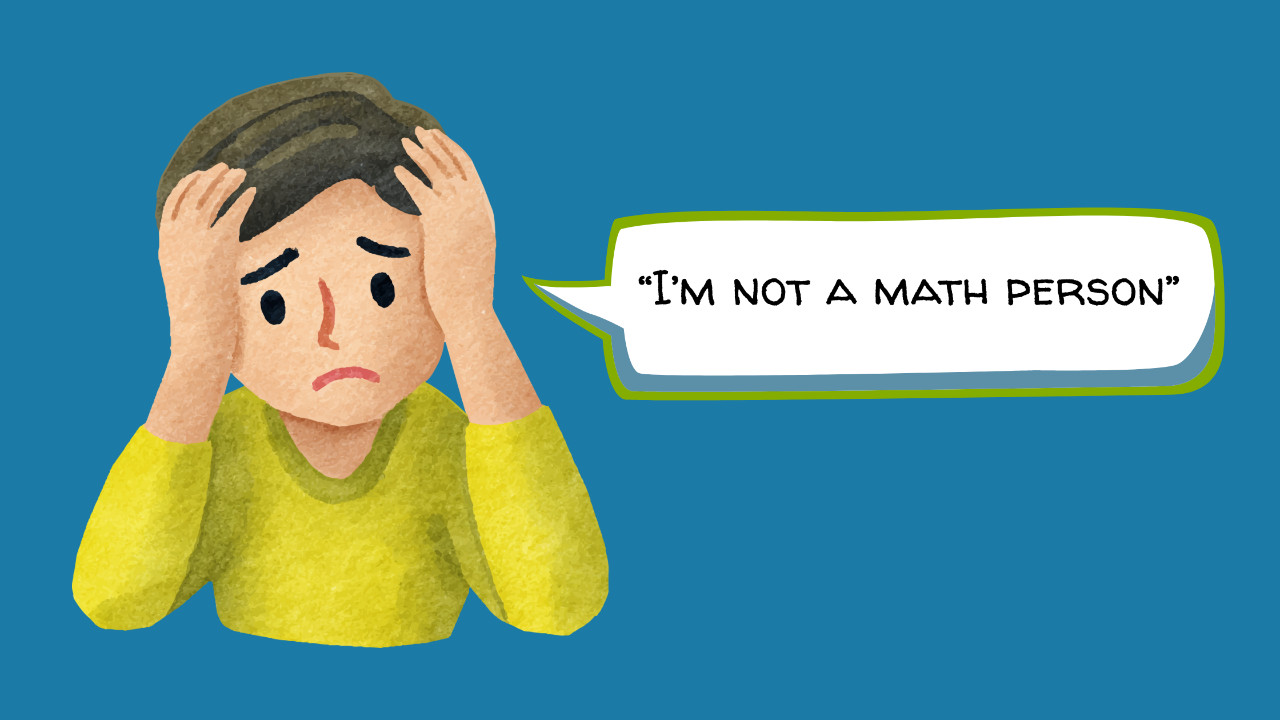
I Thought I Wasn't a Math Person (Until I Learned What Math Actually Is)
A guest post by Kristi Gottwalt, Director of Marketing at Math is FigureOutAble
You know people like me. You may be people like me.
For nearly two decades in the ed tech field, I've watched from the sidelines as students got access to tools I could only dream of as a kid. Walking through vendor halls at conferences, I'd feel a pang of jealousy—all these amazing resources to help the latest generation connect with subject matter in ways that seemed almost magical.
But here's what I didn't realize: no amount of fancy tools can fix broken math instruction.
The Phrase We Don't Say Anymore
Before I met Pam Harris and the Math is FigureOutAble team, I was the first to say it: "I'm not a math person." It's a phrase that's now banned around our office, and within a few short months of working here, I understood exactly why.
I didn't fail at math. My math instruction failed me.
I aced history and English. I muddled through science. But math? Math was a true struggle that made me feel stupid, even though I knew I wasn't. The problem wasn't my brain. It was that my teachers didn't have the know-how to help me reason through math. I sucked at memorizing algorithms, and that was treated as the only way to "do" math - because we were all in the dark.
When Fractions Became the Villain
So when the team started talking about our next Math is FigureOutAble Challenge focusing on fractions, I was leery. Actually, let me be honest: I dreaded it. Fractions made me feel dumb in a way few other topics could.
Then Pam mentioned Vanessa Vakharia and Math Therapy, where Pam was a guest. Something clicked. The concept of "math trauma" wasn't just some buzzword. It was exactly what had affected me.
One quote from Pam hit me hard:
"So I'm going to suggest there are naturally mathy people who have maybe some natural talent or have enough natural interest that they go for it. And either one of those is enough for them to sort of take interest. Here's my point. We can all be mathy people, but we have to know what the actual mathy thing is."
Wait. We can all be mathy people?
That's when I asked Pam to explain fractions to me—the figure-out-able way.
The Moment Everything Changed
When Pam explained how fractions actually work in a way that made sense, it seemed so simple. Not simple like "easy." Simple like "logical." Like something my brain could actually grab onto and understand. I was no longer in the dark.
She started with something concrete: a chocolate bar broken into 4 parts. When you share that chocolate bar with friends, suddenly 1/4, 2/4, and 3/4 aren't abstract symbols. They're pieces of chocolate you can picture. Then she introduced another chocolate bar. And just like that, the idea of five ¼ segments being 5/4 clicked. It was something I could actually see in my head.
There was more to it than that. But this was my first aha moment. And it made fractions less daunting in a way that years of algorithm memorization never had.
In her Building Powerful Fractions, 1 workshop, Pam unpacks the five different meanings of fractions. Most of us were only ever shown part-whole, and even then, usually in a rushed or procedural way. But when she walks through the other four meanings and connects them back to visuals and relationships, you start to see why fractions feel so confusing for so many people. We weren’t bad at math. We were missing the bigger picture.
I felt two things simultaneously: clarity and regret. Clarity that I could understand this. Regret that my third-grade self never got this opportunity.
The root of my math trauma? It came from fractions. From being taught algorithms to memorize instead of concepts to understand. From being one of the students Vanessa described on that podcast:
"The rest of the class is not "quote unquote" good at math in this way, and they don't feel good. They aren't presented with any other options. They just leave the class thinking, well, I guess I'm not a math person and I'm not good at it."
Pam's response? "Uh yes. And what a tragedy."
What a tragedy indeed.
It's Not Too Late (For Any of Us)
Here's what working at Math is FigureOutAble has taught me: I am not too old to think like a mathematician. None of us are.
I'm someone who's constantly learning. Professionally, as a marketer, I need to understand complex products and industries. I follow current events, I'm passionate about history, I'm an avid reader. My brain works just fine.
What I needed wasn't a different brain. I needed different math instruction.
And here's the thing that keeps me up at night: there are students sitting in classrooms right now, feeling exactly the way I did. Smart kids who are being told, implicitly or explicitly, that they're "not math people" simply because memorizing algorithms doesn't work for them.
Vanessa put it perfectly when she asked Pam:
"You at one point said, our students deserve to learn these reasoning skills. You know, we don't need them to just pump out answers anymore. They deserve this, and we are robbing them of that if we don't facilitate that. How do you think learning in the way that you're proposing versus learning the standard algorithm actually shapes math identity?"
Our students deserve to learn reasoning skills. They deserve to understand what they're doing and why it works. They deserve to develop actual mathematical thinking instead of just memorizing steps.
And we're robbing them if we don't make this happen.
Explore a Different Way to Teach Math
That’s why I’m genuinely excited about the free Development of Mathematical Reasoning workshop.
This free K–12 workshop helps teachers experience mathematics as something students can reason through and make sense of, not just memorize.
What Makes This Different?
Pam walks you through how to help students develop mathematical reasoning instead of relying on tricks and procedures. You’ll learn by doing math yourself and experience firsthand how reasoning creates deeper understanding and confidence.
The workshop is designed to help teachers see the why behind effective math instruction and discover practical ways to support students as thinkers and problem solvers.
What to Expect
Inside the workshop, you’ll:
- Explore how mathematical reasoning develops across grade levels
- Experience the idea that “Math is figure-out-able!”
- Learn practical strategies you can use in your classroom right away
- See how students can build understanding instead of memorizing disconnected rules
- Gain insight into instruction that supports all learners
Whether you teach elementary, middle, or high school students, the ideas in this workshop can help you create classrooms where students make sense of mathematics and build confidence in their own thinking.
For younger learners, that means building strong foundations from the beginning.
For older learners, it means helping students reconnect with mathematics in a way that feels understandable, empowering, and accessible.
What You Get (All Free!)
- 6 weeks of access to the workshop so you can learn at your own pace
- Professional learning focused on developing mathematical reasoning
- Practical ideas you can implement immediately
- Support and encouragement from a community of educators
- A new perspective on what math instruction can look like
Because here’s what I’ve learned: we can all be math people. We just need opportunities to reason, think, and make sense of mathematics.
Ready to figure it out together?
👉 Sign up for the free workshop
P.S. If you've ever said "I'm not a math person," this workshop is especially for you. Trust me on this one.
Author
Pam Harris
Math Educator
Pam Harris is a mom, a former high school math teacher, a university lecturer, an author, and she wants to change the way we view and teach mathematics. While Pam was teaching high school math, her four children grew and mathematized their world in a way she had never imagined. “I had always bought into the myth that math is a disconnected set of facts to memorize, with rules and procedures to mimic. I now call that fake math.” Pam’s own kids, research, and experiences teaching real math have shown her what it means to mathematize and to support learners in their own journeys. Real math is thinking mathematically, not just mimicking what a teacher does on the board. You can shift your brain from using rote memory to mathematizing. Pam helps teachers make this shift for themselves, and helps teachers teach in a way that supports students to learn real math.
Stay connected with news and updates!
Categories
All Categories