When "Covered" Doesn't Mean Understood: Building Reasoning in Middle School Math
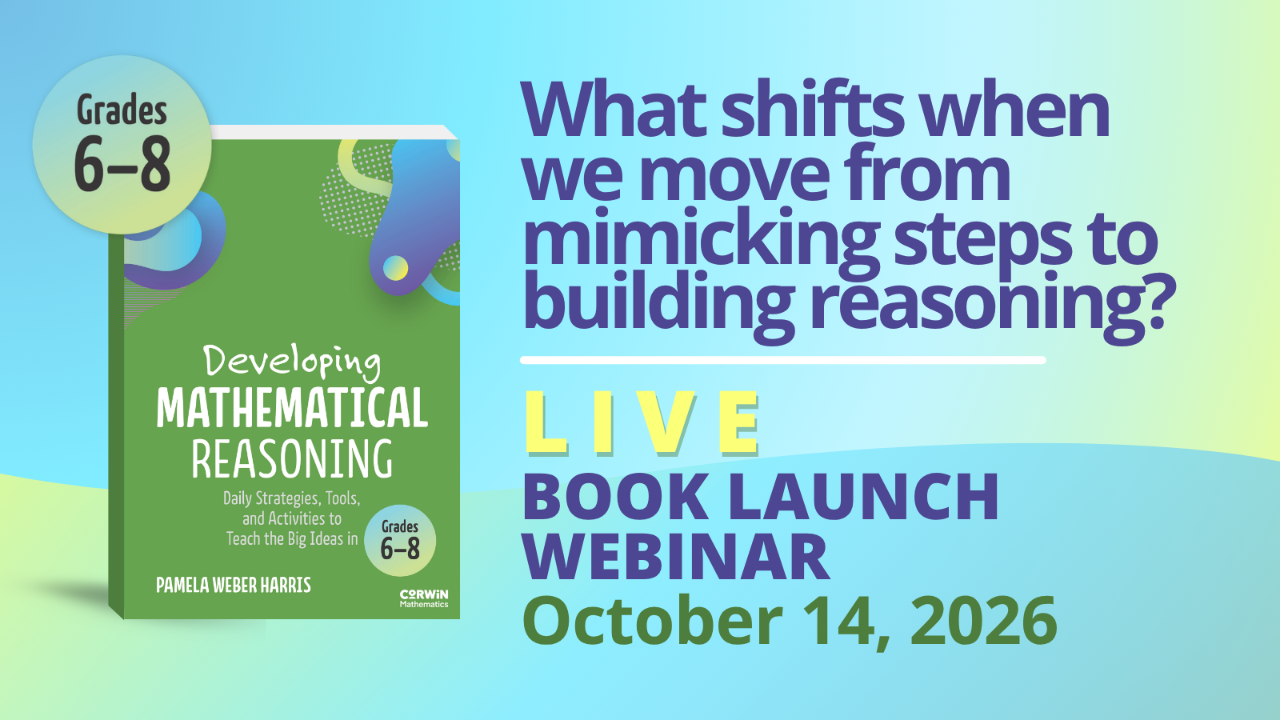
Guest blog post written by Kourtney Peters, former middle school mathematics teacher and current member of the Math is FigureOutAble content team. This blog is adopted from a passage in the book: Developing Mathematical Reasoning: The Strategies, Models, and Lessons to Teach the Big Ideas in Grades 6-8.
Memorized Rules Caused Confusion
 I’m starting a unit on solving equations with a new group of 7th graders when I realize they're struggling with an embedded skill their previous teacher assured me they had already "covered": adding and subtracting integers.
I write the problem –5 – (–3) on the board.
Lauren immediately chimes in, "The answer is negative!"
Even though the answer is, in fact, negative, I respond with a neutral question: "You think the answer is negative? Why?"
"Well," she explains, "there are three negatives, and three is odd. If there are an odd number of negatives, the answer is negative."
Oof.
Lauren had faithfully memorized a rule about multiplying integers and applied it to a subtraction problem. In that moment, I knew we had some work to do.
Stories like Lauren's fueled my search for a better way to teach mathematics. I didn't want students memorizing rules. I wanted them thinking.
Over the years, I tried all kinds of routines to make that happen: rich tasks, number talks, and anything else that encouraged students to share strategies and make sense of mathematics.
But I noticed a problem.
My Students Weren't Learning From Each Other
When one student explained their thinking, I was fully engaged. I was writing on the board, asking clarifying questions, and genuinely excited to uncover the creativity and reasoning behind their strategy.
The other students? Not so much.
The rule-followers often felt frustrated because they didn't have something concrete to copy and repeat. To them, strategy discussions seemed like unnecessary detours when all they wanted was a set of steps to get the answer.
Students who struggled both with following established procedures and creating their own approaches often withdrew from the conversation altogether. They weren't getting a high enough dose of any particular pattern or strategy to make it their own. Hearing three students describe three different methods wasn't enough repetition or coherence to help them build understanding.
Even the students who loved finding patterns weren't learning much from their classmates' ideas. More often than not, they were simply waiting for their turn to share.
In other words, I became very good at understanding how my students thought. I even learned some new strategies along the way. But my students weren't gaining much from our "share all the strategies" approach to building fluency.
Very few could remember or apply a classmate's strategy when a similar problem appeared the next day.
That left me wondering: What was the point of encouraging students to discover strategies if those strategies weren't helping them solve similar problems, let alone tackle new situations they had never seen before?
The Algorithm Temptation
At this point, many teachers might turn to algorithms.
After all, algorithms are relatively easy to teach. Students can often use them successfully within a unit, and struggling learners can experience some short-term success by following the prescribed steps.
But I knew that wasn't what I wanted.
I'd seen too many students become tangled in a web of disconnected rules, trying to remember which procedure belonged to which type of problem.
Instead, I wanted my classroom students to experience mathematics the way my tutoring students and my own children did: through careful thinking, noticing patterns, and using relationships they already understood to make sense of new ideas.
The challenge was that I wasn't quite sure how to make that happen consistently in a classroom full of students.
What Problem Strings Changed
Then I found Math is FigureOutAble and Problem Strings.
What immediately excited me about Problem Strings was that they provided exactly what I had been missing: a student-friendly routine that invites all learners to use relationships to solve problems.
A well-designed Problem String has a clear purpose. Sometimes the goal is to develop a strategy. Sometimes it's to build a model. Sometimes it's to uncover and understand a big mathematical idea.
In my middle school classroom, Problem Strings created opportunities for students to grapple with relationships they may not have noticed before and then immediately use those relationships on the next problem in the sequence.
That's what had been missing.
Students weren't just hearing about strategies. They were actively using them. They were getting a high enough dose of important patterns and relationships to make those ideas stick.
As a result, I watched students strengthen their reasoning while simultaneously becoming more competent problem solvers.
Problem Strings gave me the structure I needed to create the kind of classroom culture I had always wanted: one where students engage in meaningful mathematical discussions, develop ownership of important ideas, and gain confidence in tackling unfamiliar problems, all while maintaining mathematical rigor.
Reasoning First, Answers Second
Ultimately, our role as teachers is to help student mathematicians develop their mathematical reasoning.
We are mentors, helping students build the mental connections and pathways that allow them to make sense of mathematics.
When we tell a student, "Your answer is wrong," "You've counted incorrectly," or "You've messed up the steps," and then immediately provide the correct answer or procedure, we may improve the result in that moment.
But the student's reasoning hasn't necessarily grown.
Correct answers matter. They always will.
But right answers are necessary, not sufficient.
If we want students to become powerful mathematical thinkers, we must create opportunities for them to reason, connect ideas, notice patterns, and build understanding that extends beyond the next assignment or test.
This post is adapted from ideas explored in Pam Harris's new book, Developing Mathematical Reasoning: The Strategies, Models, and Lessons to Teach the Big Ideas in Grades 6–8. To learn more about how to foster reasoning-rich mathematics classrooms, join us for our free book launch webinar:
📅 Date: October 14, 2026
⏰8:00 PM ET | 7:00 PM CT | 6:00 PM MT | 5:00 PM PT
Register here.
Author

Pam Harris
Math Educator
Pam Harris is a mom, a former high school math teacher, a university lecturer, an author, and she wants to change the way we view and teach mathematics. While Pam was teaching high school math, her four children grew and mathematized their world in a way she had never imagined. “I had always bought into the myth that math is a disconnected set of facts to memorize, with rules and procedures to mimic. I now call that fake math.” Pam’s own kids, research, and experiences teaching real math have shown her what it means to mathematize and to support learners in their own journeys. Real math is thinking mathematically, not just mimicking what a teacher does on the board. You can shift your brain from using rote memory to mathematizing. Pam helps teachers make this shift for themselves, and helps teachers teach in a way that supports students to learn real math.
Stay connected with news and updates!
Categories
All Categories