
Building Powerful Subtraction Online Workshop
Building Powerful
Subtraction Workshop
Teachers, are you ready to. . .
✔ Master teaching subtraction?
✔ Reach more of your students?
✔ Give your students confidence and success?
Teachers, are you ready to. . .
✔ master teaching subtraction?
✔ give your students confidence?
✔ nix rote-memorized procedures?
Ready to conquer subtraction?
We got you.
This workshop is everything you need. 7 modules, 7 weeks, a powerful transformation to make a REAL impact for your students.
Teachers - looking for packages to support groups?
"If you have even one student in your class that struggles with math, then take a Pam Harris workshop."
-Christopher Peterson, West High School, CA
Ready to conquer subtraction?
We got you.
This workshop is everything you need. 7 modules, 7 weeks, a powerful transformation to make a REAL impact for your students.
"If you have even one student in your class that struggles with math, then take a Pam Harris workshop."
-Christopher Peterson, West High School, CA
From Participants of the Live Workshop
How will this workshop help your students?
Will taking this workshop empower me to help all of my students?
Rhonda says this work will give your students power.
This workshop helps Daniel, a high school teacher, reach ALL of his students!
I teach younger students. Is this Workshop for me?
Should you take this workshop?
Sara is a second grade teacher who gained confidence with subtraction and how to build it with her students.
"This training EXPANDED my brain and I can do the same for my kids!" says Beatriz.
From Participants of the Live Workshop
From Participants of the Live Workshop
How will this workshop help your students?
Rhonda says this work will give your students power.
Will taking this workshop empower me to help all of my students?
This workshop helps Daniel, a high school teacher, reach ALL of his students!
I teach younger students. Is this Workshop for me?
Sara is a second grade teacher who gained confidence with subtraction and how to build it with her students.
Should you take this workshop?
"This training EXPANDED my brain and I can do the same for my kids!" says Beatriz.
Is this PD really worth it?
Lavell had only good things to say.
"The best PD I've ever had... relevant... revolutionary... this is what we need."
A 7-week deep dive into Subtraction

Learn:
- The 2 big ideas of subtraction and how to develop them
- The most important models for subtraction, the order to use, and their purposes
- How to develop the top strategies for powerful subtraction
Runs September 22, 2026 - January 11, 2027. That is 7 weeks of content with 9 additional weeks access. All for $347!
FYI, this is the last time that workshops will be offered at the current price. Last opportunity at this price!
A 7-week deep dive into Subtraction

Learn:
- the 2 big ideas of subtraction and how to develop them
- the most important models for subtraction, the order to use, and their purposes
- how to develop the top strategies for powerful subtraction
Runs September 22, 2026 - January 11, 2027.
That is 7 weeks of content with 9 additional weeks access. All for $347!
FYI, this is the last time that workshops will be offered at the current price. Last opportunity at this price!
What is in the Workshop?
Module 1: What Does It Mean to Think Additively about Subtraction?
What is in the Workshop?
Module 1: What Does It Mean to Think Additively about Subtraction?
What Will I Learn?
- What "Math is Figure-Out-Able" means, what is real math, and what it means to mathematize
- What it means to be a mentor to young mathematicians
- Why it is important to develop reasoning, not just get answers
- Why the traditional subtraction algorithms are not the goal
- Steps to take action in your classroom
Why Is This Important?
This is the why, the background, the setting that sets the stage for the rest of the workshop, so that you can implement lessons and strategies knowing how it all fits together.
___________________________________________________
Module 2: Building Strategies
What Will I Learn?
- The two interpretations of subtraction and why students need to deeply understand both of them
- A spatial model for representing student thinking
- Problem Strings to build strategies with students
- Steps to take action in your classroom
Why Is This Important?
Students need to deeply understand the two interpretations of subtraction so they can reason about subtraction across varying contexts. They also need both interpretations in order to decontextualize and develop intuition for efficient subtraction strategies. Owning numerical relationships leads to solving problems in efficient, clever, and creative ways.
___________________________________________________
Module 3: The Connection Between Addition and Subtraction
What Will I Learn?
- Instructional routines to build number sense and numerical relationships
- A Problem String to cinch the strategies related to the two interpretations of subtraction
- How the big mathematical idea of equivalence contributes to efficient problem solving
- Steps to take action in your classroom
Why Is This Important?
It is not enough for students to solve problems if they are not also growing in mental sophistication. As students build numerical relationships, they draw on them to solve problems in clever and sophisticated ways. Students look at the problem and let the numbers dictate the strategy based on the inherent relationships.
___________________________________________________
Module 4: Getting More Sophisticated
What Will I Learn?
- A Problem String to introduce the most sophisticated subtraction strategy
- Strategies for finding partners of 100 and why this relationship is so important to subtraction work
- How context and decontextualizing contribute to sense making and flexibility
- Steps to take action in your classroom
Why Is This Important?
Students need to own sophisticated strategies so they can solve subtraction problems within other work they are doing without getting bogged down. Students frequently subtract, especially from decade and century numbers, when reasoning about multiplication and division problems. Building sophisticated subtraction strategies helps students become more flexible and fluid in multiplicative reasoning.
___________________________________________________
Module 5: Top 3 Types of Tasks for Student Success
What Will I Learn?
- What Rich Tasks are and how they can be used to develop big ideas
- Problem Strings to introduce and solidify strategies, models, and big ideas
- How Problem Strings and Problem Talks work together and how to sequence lessons to maximize learning
- Steps to take action in your classroom
Why Is This Important?
This is the how-to-do-it module. We study different types of instructional tasks and routines, discerning their role in constructing mathematical ideas in learners’ brains. Our goal is to always be moving the math and the mathematician forward. Understanding how to use and leverage different instructional tasks allows you to ensure success for all your students all of the time.
___________________________________________________
Module 6: High-leverage Teacher Moves that Help You Help Your Students
What Will I Learn?
- High leverage teacher moves to encourage student sense making
- Teacher moves that support equity and access
- Teacher moves to differentiate—to support and challenge all learners
- How to support meaningful discourse to facilitate learning
- Steps to take action in your classroom
Why Is This Important?
Teaching in a way that allows all students to learn and grow is not a trivial task. There are purposeful moves teachers can make that promote class discussion and mathematical dialogue, position all students as sense makers, and build a culture of curiosity and empowerment.
In this module, you’ll learn the high level teacher moves that make the learning happen like a pro.
___________________________________________________
Module 7: Developing Subtraction in Younger Learners and Extending Subtraction in Higher Math
What Will I Learn?
- How to help beginners reason about the relationship between addition and subtraction
- Beginning subtraction strategies for young learners
- How to help students think and reason through integer subtraction
- How to help students think and reason through algebra applications without using an algorithm/formula
- Steps to take action in your classroom
Why Is This Important?
This workshop starts with the assumption that some subtraction work has already happened. If you work with students who do not own the single-digit subtraction facts, this module gives you tools to help support their mathematical development.
Subtraction doesn’t stop in 5th grade, but older students often won’t engage in a review of subtraction, no matter how much they need it. Teachers in middle and high school need an entry point to build subtraction in the content they teach. Here we identify places subtraction naturally comes up in middle and high school content and how to build subtraction while addressing grade level content.
___________________________________________________
Live Q&A Sessions With Pam
During the workshop you will have the opportunity to submit questions to Pam for her to answer during two live Q&A sessions. The sessions will be recorded and you will have access to them.
What is in the Workshop?
Module 1: What Does It Mean to Think Additively about Subtraction?
What is in the Workshop?
Module 1: What Does It Mean to Think Additively about Subtraction?
What Will I Learn?
- What "Math is Figure-Out-Able" means, what is real math, and what it means to mathematize
- What it means to be a mentor to young mathematicians
- Why it is important to develop reasoning, not just get answers
- Why the traditional subtraction algorithms are not the goal
- Steps to take action in your classroom
Why Is This Important?
This is the why, the background, the setting that sets the stage for the rest of the workshop, so that you can implement lessons and strategies knowing how it all fits together.
_____________________
Module 2: Building Strategies
What Will I Learn?
- The two interpretations of subtraction and why students need to deeply understand both of them
- A spatial model for representing student thinking
- Problem Strings to build strategies with students
- Steps to take action in your classroom
Why Is This Important?
Students need to deeply understand the two interpretations of subtraction so they can reason about subtraction across varying contexts. They also need both interpretations in order to decontextualize and develop intuition for efficient subtraction strategies. Owning numerical relationships leads to solving problems in efficient, clever, and creative ways.
_____________________
Module 3: The Connection Between Addition and Subtraction
What Will I Learn?
- Instructional routines to build number sense and numerical relationships
- A Problem String to cinch the strategies related to the two interpretations of subtraction
- How the big mathematical idea of equivalence contributes to efficient problem solving
- Steps to take action in your classroom
Why Is This Important?
It is not enough for students to solve problems if they are not also growing in mental sophistication. As students build numerical relationships, they draw on them to solve problems in clever and sophisticated ways. Students look at the problem and let the numbers dictate the strategy based on the inherent relationships.
_____________________
Module 4: Getting More Sophisticated
What Will I Learn?
- A Problem String to introduce the most sophisticated subtraction strategy
- Strategies for finding partners of 100 and why this relationship is so important to subtraction work
- How context and decontextualizing contribute to sense making and flexibility
- Steps to take action in your classroom
Why Is This Important?
Students need to own sophisticated strategies so they can solve subtraction problems within other work they are doing without getting bogged down. Students frequently subtract, especially from decade and century numbers, when reasoning about multiplication and division problems. Building sophisticated subtraction strategies helps students become more flexible and fluid in multiplicative reasoning.
_____________________
Module 5: Top 3 Types of Tasks for Student Success
What Will I Learn?
- What Rich Tasks are and how they can be used to develop big ideas
- Problem Strings to introduce and solidify strategies, models, and big ideas
- How Problem Strings and Problem Talks work together and how to sequence lessons to maximize learning
- Steps to take action in your classroom
Why Is This Important?
This is the how-to-do-it module. We study different types of instructional tasks and routines, discerning their role in constructing mathematical ideas in learners’ brains. Our goal is to always be moving the math and the mathematician forward. Understanding how to use and leverage different instructional tasks allows you to ensure success for all your students all of the time.
_____________________
Module 6: High-leverage Teacher Moves that Help You Help Your Students
What Will I Learn?
- High leverage teacher moves to encourage student sense making
- Teacher moves that support equity and access
- Teacher moves to differentiate—to support and challenge all learners
- How to support meaningful discourse to facilitate learning
- Steps to take action in your classroom
Why Is This Important?
Teaching in a way that allows all students to learn and grow is not a trivial task. There are purposeful moves teachers can make that promote class discussion and mathematical dialogue, position all students as sense makers, and build a culture of curiosity and empowerment.
In this module, you’ll learn the high level teacher moves that make the learning happen like a pro.
_____________________
Module 7: Developing Subtraction in Younger Learners and Extending Subtraction in Higher Math
What Will I Learn?
- How to help beginners reason about the relationship between addition and subtraction
- Beginning subtraction strategies for young learners
- How to help students think and reason through integer subtraction
- How to help students think and reason through algebra applications without using an algorithm/formula
- Steps to take action in your classroom
Why Is This Important?
This workshop starts with the assumption that some subtraction work has already happened. If you work with students who do not own the single-digit subtraction facts, this module gives you tools to help support their mathematical development.
Subtraction doesn’t stop in 5th grade, but older students often won’t engage in a review of subtraction, no matter how much they need it. Teachers in middle and high school need an entry point to build subtraction in the content they teach. Here we identify places subtraction naturally comes up in middle and high school content and how to build subtraction while addressing grade level content.
_____________________
Live Q&A Sessions With Pam
During the workshop you will have the opportunity to submit questions to Pam for her to answer during two live Q&A sessions. The sessions will be recorded and you will have access to them.
Registration closes September 18, 2026
00
DAYS
00
HOURS
00
MINUTES
00
SECONDS
Workshop starts September 22, 2026
Registration opens
May 12, 2023
As a Participant
You will experience instructional tasks so that you can build intuition in your students.
You will follow a sequence of tasks designed to give all students access so that you can help students build reasoning about subtraction based on their experiences and what they are naturally thinking.
You will extend the learning to more complicated contexts so that you can strengthen students' reasoning.
You will engage in problem solving so that you can parse out the thinking needed to solve problems while reasoning about subtraction.
You will learn actionable strategies while engaging in the instructional routine called Problem Strings so that you can develop students' sense of subtraction and build specific mathematical strategies.
You will study three lesson types so that you can to learn to introduce, construct, and solidify reasoning about subtraction.
You will analyze expert teacher moves so that you can energize your classroom and keep students engaged in sense making.

I’m Pam Harris and I empower teachers to be the teacher they want to be.
______________________________________________________
I have been working with educators for over 20 years as a classroom teacher, university instructor, and teacher trainer as well as writing books and creating resources for teachers.
As a beginner teacher, I worked hard to make lessons understandable and interesting but I didn’t realize how much I relied on rote memorization and repeating procedures until I immersed myself in math research. This fundamentally changed the way I do and teach mathematics so that teachers and students reason mathematically, not mimic like robots.
Are you ready?

If you've heard enough and you're ready to dive in, then click below.
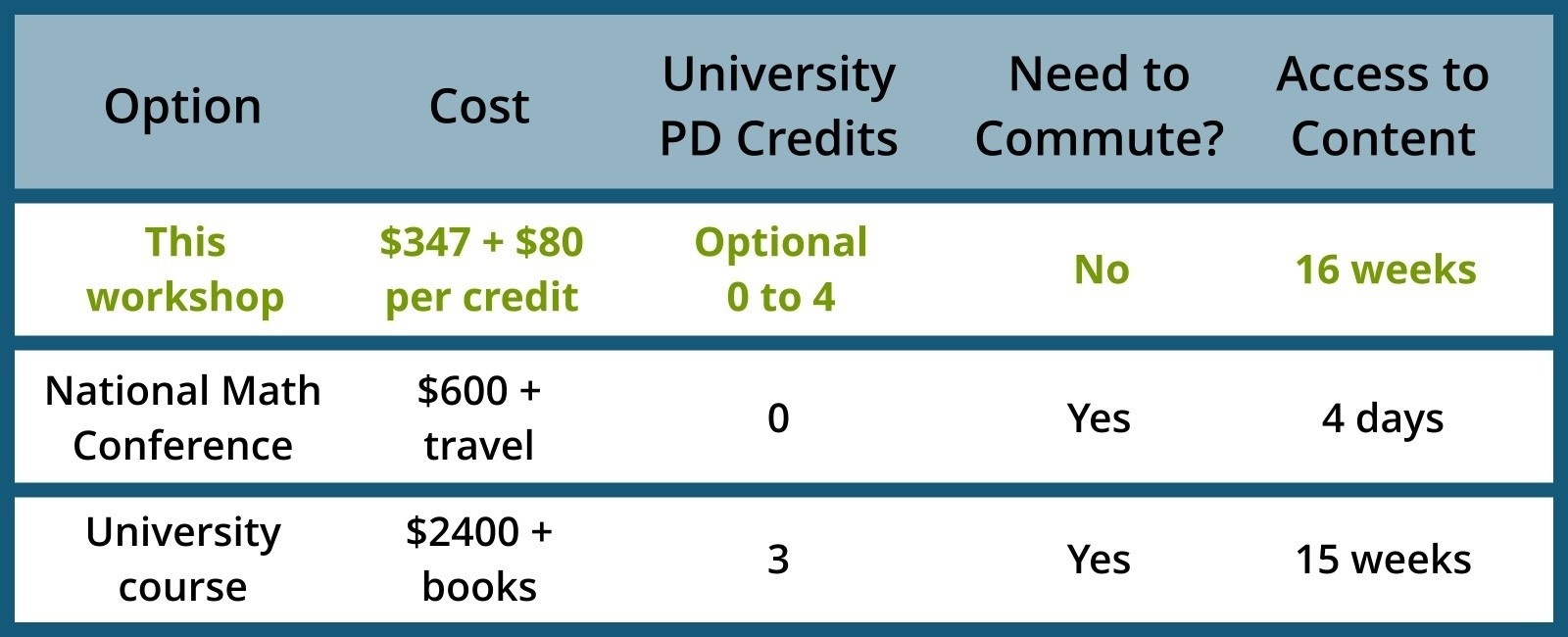
The workshop costs $347, which is less than the registration cost for many large conferences and also way more convenient.
How Does The Workshop Compare?
Learn more about how to earn credits through University of Massachusetts Global.
Take the Workshop on Any Device

My Guarantees
✔ If you complete my workshop and do not learn anything that you can use in your classroom, email me at pam@mathisfigureoutable.com within 10 business days of the workshop ending and I will give you a full refund.
✔ You will feel very supported because there are live Q&A sessions to ask questions, bonus videos and materials, as well as optional activities.
✔ I estimate an average of 2-3 hours of work each week for this seven-week workshop. You will have access to the workshop content for 16 weeks.
Frequently Asked Questions (FAQ)
How does it compare to a math conference?
Math conferences can be hit or miss, depending on the presenters you see. In the best case scenario, you see many great presenters, but when you only spend 60 to 90 minutes with them, you rarely leave with enough experience to comfortably implement what you learned. In the worst case scenario, you see many mediocre presenters with disconnected topics and it can feel like a big waste of time.
In contrast, my workshop is an extended experience that is cohesive and coherent with specific topics. This workshop focuses on subtraction. In the course we will therefore explore lesson types, models, and high-leverage teacher moves that will help students leverage their reasoning to construct subtraction strategies.
How does your workshop compare to an online university professional development course?
Because this workshop is offered online with 7 weeks of content available for 16 weeks, you have lots of flexibility in where and when to work on it.
There are both big picture ideas to chew on and lots of activities you can implement right away in your math class.
What are the start and end dates of this workshop?
Registration opens Wednesday, August 26, 2026 at 7:00 AM CDT and ends Friday, September 18, 2026 at 7:00 PM CDT.
The workshop begins on September 22, 2026 and ends on January 11, 2027. That includes 7 weeks of content with 9 additional weeks access.
Which grade levels are this workshop intended for?
This workshop is for anyone who teaches additive reasoning, what leads into it, and what comes after. That said, it is directly for 2nd through 12th grade teachers.
Anyone who works as a leader, instructional coach, PD facilitator, or trainer will also find this workshop useful.
What technical requirements are there?
This is an online workshop, so you need to have an Internet-connected device and feel comfortable browsing websites. Most devices including computers, tablets (such as iPads), and phones should have no problem using the site.
You will need to have the ability to watch videos—some school districts block websites that play videos. If you can see the video at the top of this page, you're probably going to be fine.
Please ensure that emails from pam@mathisfigureoutable.com are being received and not going to your SPAM folder.
If none of those options allow you to receive emails from pam@mathisfigureoutable.com, then please email support@mathisfigureoutable.com and we will work to resolve the issue.
Is there a flyer I can download and print?
Yes. Download the flyer here and feel free to share it with others.
Registering for the workshop
What if I can't get approval to register before the registration deadline?
I totally get that a two-week window makes registering for my workshop challenging when it takes a long time to get approval from your administrators or school district. In most cases, we can usually find a way to make this work. Email me at support@mathisfigureoutable.com about your situation and we can take it from there.
I'm interested in your workshop, but I can't afford it. Is there something you can do?
I want this workshop to be accessible to everyone. So, please email me at pam@mathisfigureoutable.com, explain your situation, and we'll see what we can work out.
What happens right after I register?
You should receive two emails shortly after you register. One email will be a confirmation of your registration. Another email will be from me and will have all the information you'll need to get started. At the bottom of that email will be a button you can click to get started.
You can always find the workshop by logging in on the Mathisfigureoutable.com homepage and going to the My Content tab. There you will find the workshop and any other content linked to your account.
Can I pay with a purchase order?
Of course! It's a two step process.
Step 1: Gather the names and emails of all teachers being paid for with the purchase order. Send that information to support@mathisfigureoutable.com. Please format it as follows: First name Last name, Email (example@emaildomain.com)
Step 2: Fill out this Purchase Order Request Form.
We'll take it from there!
Need help requesting funding from your school?
Use this template in Google Drive or contact support@mathisfigureoutable.com for a PDF version.
The workshop experience
What role does Pam have in this workshop?
This is not a workshop where you never hear from the instructor after you sign up. In addition to sending out weekly emails about what to expect, my team and I will be very engaged on the message board and interact with posted questions and comments. Please email support@
Are your workshop videos closed captioned? Transcripts?
Yes, all videos used in this workshop have closed captions entered by hand.
In addition to closed captioning, transcripts are available for download.
Do I have to be online at a specific time for this workshop?
No. This workshop is set up so that you can do it at any time of the day or night.
How much time will this workshop take each week?
Workshop participants can spend an average of about 3.5 hours per module. There are seven modules over the seven-week workshop. Some modules, especially modules 1 and 2, require more time than others. However, remember that even though the workshop is seven weeks, you have access to the content for sixteen weeks.
What homework or extra assignments are there?
While there are no homework or extra assignments associated with this workshop, I provide several things to try in your class. We explore these tasks in terms of how you experience them, how students experience them, and how teachers facilitate them. There is a message board you can interact with others on. There are no papers, reports, essays, or other written documents you must do as a part of this workshop.
When do the live Q&As take place?
The first Q&A takes place around the time that module 7 is released and another is held near the end of the workshop. You can add your questions to the "Live Q&As with Pam" section. I will endeavor to answer as many of these questions as I can during the scheduled workshop Q&As.
Dates, times, and information about how to join the live Q&As will be provided in your workshop specific emails and inside the "Live Q&As with Pam" module.
After the workshop ends
Can I earn a Professional Development Unit (PDU) for this workshop?
Yes! We are partnered with University of Massachusetts Global so you can earn 1 to 4 Graduate Level Professional Development Units. In order to earn PDU's, you need to apply for admission to University of Massachusetts Global, pay $80 per PDU, complete the online workshop, and complete the university's assignments.
Go to the Pam Harris Consulting partnership page, then click on Register Now to get started. Choose EDTU 9144 to register for Building Powerful Subtraction.
Please check with your school or district to determine whether these credits are accepted. Note that these credits require additional fees ($80 per credit) and follow-up assignments.
Can I get a certificate of participation?
Yes. After you complete all the lessons and the workshop feedback form, you will receive an electronic certificate of participation via email. If you need specific information on your certificate of participation, just email support@mathisfigureoutable.com and explain what you need to have added.
What is your refund policy?
If you complete my workshop and do not learn anything that you can use in your classroom, email me at pam@mathisfigureoutable.com within 10 business days of the workshop ending and I will give you a full refund.